Hey, all. I'm glad you've liked this blog thus far. I've enjoyed the feedback I've gotten from it.
Unfortunately, I've been under quite a bit of stress lately with job and apartment hunting, writing my dissertation and wishing my friends a fond farewell. This blog is for my and your enjoyment, but I haven't been able to take pleasure in writing it while these other obligations are tugging at my mind's coat sleeves. The knowledge that I've been remiss in my duties has only added to the stress. So for the time being, I'm putting the Language Loft on hold.
If you have any words or idioms you'd like explored in the meantime, please don't hesitate to comment on my entries or on the blog's Facebook page. When I resume the blog, I will address your requests.
Thank you for reading. Until then, take care of yourselves and stay shiny.
Sunday, August 26, 2012

Tuesday, August 7, 2012
"You keep using that word. I do not think it means what you think it means."
Hey logonauts! Do you have any language-related pet peeves? I know I do, and if annoying me were an Olympic event, the misuse of the two words we'll discuss today would win at least bronze (though I wouldn't be handing out precious metals for irritating me -- that's just silly). Today you're getting a double header in this post, and first we'll be addressing the word "sarcasm."
On average, people popularly refer to any sort of joking speech expressing a sentiment other than the truth as sarcastic. My flatmate calls me a barbarian for putting anything on my crumpets other than butter and jam, and I joke with her about needing the Crazy Cat Lady Starter Kit. But they're just jokes. She just happens to love cats more than the average person, and...well, I'm joking.
Anyway, the point is that such comments aren't sarcasm. Sarcasm mocks or ridicules with the intent to do harm, and the sallies that friends and family make at each other in jest don't qualify. The Oxford English Dictionary defines sarcasm as "a sharp, bitter or cutting expression or remark" or "a bitter jibe or taunt." Telling an overweight person eating a doughnut that he or she is doing a great job on his or her diet would be sarcasm, for instance. It needn't even deviate from the truth; if a co-worker manages to spill his glass of water thrice in one evening despite his brand-new bartending degree, telling him that he couldn't serve a drink in a bathtub would be sarcastic, and would be cruel at that. (But if your co-worker won't stop patting himself on the back for his skill at making cocktails, chances are that you'd be waiting for a good opportunity for some schadenfreude*).
The harshness associated with sarcasm becomes clear if we examine the etymology of the word; it comes from Greek σαρκασμός, or sarkasmós, from σαρκάζειν, or sarkázein, "to tear flesh." The Greek root σαρκ, "sark-," is the same root from which we derive sarcophagus, the name for the typically stone coffins used by the ancients to hold the bodies of the dead. The name, a Greek compound meaning "flesh-eating," comes from the belief that the type of stone typically used to create the coffins consumed the flesh of the bodies within. Remembering that sarcasm comes from a word meaning "flesh" will help you remember that people wield sarcasm not to jest or tease, but to wound.
Nowadays sarcasm is mistakenly applied to examples of verbal irony, or enantiosis, which dictionary.reference.com defines as "the use of words to convey a meaning that is the opposite of its literal meaning." While sarcasm can take the form of irony -- for example, calling someone a genius for saying something obvious -- not all sarcasm is ironic, and not all irony is sarcastic. When it starts raining and you say, "Nice weather we're having," or when you drop a cake on the floor and say, "I meant to do that," you're not being sarcastic because you're not insulting anyone. You're employing verbal irony.
Yet irony itself poses some problems. Dictionary.reference.com's blog, The Hot Word, has suggested that ironic may be "the most abused word in English." An infamous example is Alanis Morissette's 1995 song "Ironic."
Critics and comedians excoriated Morissette for her song's lyrics, prompting parodies ranging from famous comedy roasts** of the song to a version of the lyrics modified to make them truly ironic. And Alanis is not alone in her misuse of the word. There's even a website, IsItIronic.com, to help you determine whether you can classify your particular situation as ironic. (It also sports an entire tab devoted to Alanis Morissette.)
The type of irony Alanis tries to invoke in her song is situational irony, and this is the kind of irony that people tend to define incorrectly. Common mistakes include applying ironic to something merely out of the ordinary, such as a cold day in July, or to something unexpected, such an expensive meal at a five-star restaurant tasting awful. Another example of mistaken irony is the coincidence, such as a chance meeting with a friend at the movie theater who happens to be seeing the same film, or the same car following your car down the route you're taking and parking in the same parking lot.***
So if none of the above is situational irony, what is situational irony? After all, dictionary.reference.com's definition of this form of irony is somewhat misleading: "an outcome of events contrary to what was, or might have been, expected." Unexpected outcomes can include all sorts of things: no one expects a coincidence to occur, just as a hot day in England during December is contrary to expectations. The Oxford English Dictionary's definition adds some helpful remarks, but isn't much better: "a condition of affairs or events of a character opposite to what was, or might naturally be, expected; a contradictory outcome of events as if in mockery of the promise and fitness of things." We're getting warmer, but we're more in Murphy's Law territory than we are approaching a definition of irony. Even the following quotation from the New York Times stylebook does more to establish what irony isn't than what it is:
"Not every coincidence, curiosity, oddity and paradox is an irony, even loosely. And where irony does exist, sophisticated writing counts on the reader to recognize it."The short answer is that people still disagree. I've sifted through several conflicting definitions, and I'm still not 100 percent certain I've pinned down the right one. But the explanation of situational irony that makes the most sense to me is the following: it occurs when someone takes specific actions to achieve a certain outcome, but those actions produce an outcome that is the opposite of what he or she intended. Judging from that definition, intent is a critical part of determining whether or not a situation qualifies as ironic.
For instance, a veterinarian accidentally hitting a cow with his car is not ironic -- just sad. But if the veterinarian was on a job and intended to save the dying cow that he accidentally kills with his car, that's situational irony. Setting a bowl of water atop a freezer door so that it spills on the next person who opens the freezer is a good prank, but if the person who sets the trap forgets about it and drenches himself instead, that's situational irony, too. A billboard warning drivers to keep their eyes on the road that instead distracts drivers and causes accidents? A company forced to recall 80,000 of its buttons promoting toy safety because the buttons themselves were unsafe (see bottom of article)? Take a guess.
But some situations that fall outside of that definition still seem awfully ironic, don't they? A forger selling a fake antique as the real thing but getting paid in counterfeit money, for instance, or other examples of poetic justice -- shouldn't those be called ironic as well?
I'm tempted to agree with the criteria for situational irony proffered by Dr. Martin Maner of Wright State University: "an outcome must be not only contrary to expectation, but perversely and strangely appropriate." In other words, a situation must entertain us and appeal to our sense of the absurd in order for it to qualify as ironic.
Yes, I think I can agree with that.
Irony's power to entertain brings us to another use of irony. Theater and movie buffs will likely be familiar with dramatic irony, which occurs when the audience knows something that one or more characters in the play or film do not. Sophocles' classic (and classic) work, Oedipus the King, teems with dramatic irony. Oedipus' vow to bring the murderer of the previous king of Thebes to justice is a fine example, for the audience knows that (spoiler!) King Laius' murderer is someone Oedipus knows all too well. (Fun fact: King Laius was also slain in what was perhaps one of the first recorded incidents of road rage in the Western world.)
One of my favorite films, Eternal Sunshine of the Spotless Mind, also features dramatic irony as a major theme. The film begins with a man, Joel, and a woman, Clementine, having a seemingly chance meeting on a train, but the movie quickly reveals that they were in love once and went to a doctor to have their memories of each other erased. The audience experiences Joel's memories as the lab technicians erase them, and when the story returns to the former couple in the present, we remember what they chose to forget.
And while we're on the subject of what we know and don't know, the last form of irony we'll be discussing is Socratic irony. A vital tool of the Socratic method, Socratic irony occurs when a speaker feigns ignorance about a subject to prompt his or her students or fellow conversationalists to give their opinion. Then, after they present an argument and the speaker's feigned ignorance puts them at ease, the speaker asks pointed questions of the person(s) who gave the argument, demonstrating flaws in it and proving himself or herself the more skilled debater, despite the sustained show of false modesty. As Shakespeare demonstrated so clearly, and as many comedians continue to demonstrate, the person playing the fool often proves wiser than those who think themselves wise.
Think I've covered all the bases. Should you ever have a conversation with someone who misuses the words sarcasm and irony, feel free to send him or her to this blog. If you're part of the club who has used one or more of the words incorrectly, you're in good company. And if you have your own definitions for sarcasm or irony, send them my way! I'd love to hear what you have to think. Sarcasm I'm not so fond of, but I find irony a marvelous tool that enables us to better appreciate the absurdity of life. That extra layer of humor and meaning can enrich our lives so much. It's one madcap world we live in -- we should be able to laugh at it every once in a while.
'Til next time.
Information purloined from dictionary.reference.com, The Oxford English Dictionary, Columbia University's Media Center for Art History, College Humor, IsItIronic.com and The Wall Street Journal
* : Check out a previous Loft entry on the word schadenfreude for a definition and some discussion
** : Disclaimer: don't follow this link if you mind lewd humor and light profanity. But if you have the stomach for it, Ed Byrne does a hilarious send-up of the song (and provides some great examples of irony to boot!)
*** : By the way, if periodic bursts of light then come from inside the vehicle that look a lot like camera flashes, it's probably not coincidence
Monday, July 30, 2012
Something wicked this way comes
Hey readers! Thanks for bearing with me. I'm always a bit tired after a Loft entry because I tend to stay up late polishing it. I fear there's no rest for the wicked.
We'll be discussing that idiom today, made all the more popular recently by the Cage the Elephant song "Ain't No Rest for the Wicked." The irony of the Cage the Elephant song title is that ain't no forms a double negative, implying that there is, in fact, rest for the wicked.
One way Cage the Elephant could escape this problem is by claiming to be using negative concord, in which multiple negatives merely intensify the negativity of the statement. If that's the case, the band would be in good company -- plenty of artists have used negative concord in their song titles and lyrics, including Bill Withers' "Ain't No Sunshine," The Rolling Stones' [I Can't Get No] "Satisfaction," and Matthew Wilder's [Ain't Nothing Gonna] "Break My Stride." Negative concord occurs in some non-standard dialects of English, but a double negative in standard English usage results in a positive. Nonetheless, it's funnier to think of "Ain't No Rest for the Wicked" as employing a double negative to extol the virtues of crime.* But I digress. Let us return to the idiom, before this entry becomes any more like a grammar lesson.
"No rest for the wicked" first appeared in English as "no peace for the wicked." According to Gary Martin of The Phrase Finder, the phrase first appeared in the Myles Coverdale Bible, the first Bible printed (i.e. not handwritten) in English, in 1535. The phrase appears in Isaiah 48:22, 57:20 and 57:21:
People use the idiom in the modern day to refer to the necessity of continuing with their work despite their fatigue. The Phrase Finder links this shift in usage to Harold Gray's use of the idiom as the title for one of Little Orphan Annie comic strips in 1933. (See the comic strip in question by following the link above.) The comic grew in popularity from its debut strip on August 5, 1924, and by the time Gray published the strip using the idiom for a title, Little Orphan Annie was a syndicated comic in several American newspapers.
On a side note, the original Annie wasn't just a lovable waif with a talent for singing and tap-dancing; in the comic book she's punching out criminals and turning the tables on swindling businessmen. Or so the comic advertises. In fact, Susan Houston tells us that the comic-strip Annie even blows up a submarine (follow the link and read the entry under the heading "May 16, 1942"). All in a day's work, of course.**
The modern sense of the phrase can still take on a religious overtone. After all, reaching Heaven, Nirvana or whichever form of enlightenment or afterlife you [might] believe in takes perseverance. And this idea applies in a secular sense as well, if you take "wicked" to mean "imperfect." We all have shortcomings, vices and areas in which we could improve, and many people struggle their whole lives in an effort to conquer them, or at least learn to live with them.
This standpoint on the idiom brings us back to the Cage the Elephant song, which gives the phrase a whole new lease on life. I suppose you could call this interpretation the opposite of the phrase "the sleep of the innocent." In the song, a lady of the evening (working in the daytime?), a mugger, and finally the singer himself all interpret "no rest for the wicked" in the same way, and quite literally at that:
At first the song seems to say that a life of crime ensures that you will always be running, either looking for your next client, mark or victim or staying one step ahead of the police. The singer ultimately concludes, however, that "the wicked" include not just those who break the law, but all of us. As long as we're alive, we'll need money to get by and to enjoy life, and because of that, we shan't get a moment's rest until we die.
If being "wicked" is wanting to "satisfy those thrills," or in other words, to enjoy life, isn't the whole point of industriousness and working one's butt off -- of being good -- to be able to be a bit wicked every so often? Even if you're working three jobs, tackling the daily housework single-handedly, or putting yourself through school by the sweat of your own brow, the few moments of rest or enjoyment you have will allow you to plunge back into your work with renewed vigor. I know that at the end of my life, learning something new, watching a play in Shakespeare's Globe, looking over the edge of the Grand Canyon, smiling back at the woman I love and spending time in the company of friends and family will be the memories that I treasure.
If you believe in life after death, enjoy the pleasures and experiences now that the hereafter might not offer. Chances are we won't get to skydive or have snowball fights or fly-fish*** in the Great Beyond. And if you don't believe in an afterlife, all the more reason to enjoy the time you can call your own.
But as with all good things, everything in moderation.
'Til next time, logonauts.
Information purloined from The Yale Grammatical Diversity Project, The Phrase Finder, StudyLight.org, The Library of American Comics, "Little Orphan Annie: The War Years, 1939-1945, or, Heroism on the Home Front" by Susan Houston and lyrics.com
* : You haven't robbed a bank in two weeks?! How can you live with yourself?!
** : The tagline for the long-awaited sequel to Annie: "The sun will come out, tomorrow -- but not for you, Nazi scum."
*** : "I caught a big one!" "No, Larry, that's just another cherub. And you know the Big Guy's policy -- you gotta throw 'em back." "Well, I can't help it that the only bait we have around here is this endless mountain of chocolate."
We'll be discussing that idiom today, made all the more popular recently by the Cage the Elephant song "Ain't No Rest for the Wicked." The irony of the Cage the Elephant song title is that ain't no forms a double negative, implying that there is, in fact, rest for the wicked.
One way Cage the Elephant could escape this problem is by claiming to be using negative concord, in which multiple negatives merely intensify the negativity of the statement. If that's the case, the band would be in good company -- plenty of artists have used negative concord in their song titles and lyrics, including Bill Withers' "Ain't No Sunshine," The Rolling Stones' [I Can't Get No] "Satisfaction," and Matthew Wilder's [Ain't Nothing Gonna] "Break My Stride." Negative concord occurs in some non-standard dialects of English, but a double negative in standard English usage results in a positive. Nonetheless, it's funnier to think of "Ain't No Rest for the Wicked" as employing a double negative to extol the virtues of crime.* But I digress. Let us return to the idiom, before this entry becomes any more like a grammar lesson.
"No rest for the wicked" first appeared in English as "no peace for the wicked." According to Gary Martin of The Phrase Finder, the phrase first appeared in the Myles Coverdale Bible, the first Bible printed (i.e. not handwritten) in English, in 1535. The phrase appears in Isaiah 48:22, 57:20 and 57:21:
As for the vngodly, they haue no peace, saieth the LORDE. (Isaiah 48:22)The phrase is taken to refer to the eternal punishments that await sinners in Hell, as opposed to the comfort and repose awaiting the saved in Heaven. In Dante's Inferno, these punishments range from swirling about in an eternal whirlwind, to enduring fiery rain, to swimming in boiling pitch, to lying icebound in coldness so intense that your tears congeal the moment you weep. And it's hard to get some shut-eye while you're in constant pain -- especially when you've got a chunk of ice over your eyelid.
But the wicked are like the raginge see, that ca not rest, whose water fometh with the myre & grauel. (Isaiah 57:20)
Eueso ye wicked haue no peace, saieth my God. (Isaiah 57:21)
People use the idiom in the modern day to refer to the necessity of continuing with their work despite their fatigue. The Phrase Finder links this shift in usage to Harold Gray's use of the idiom as the title for one of Little Orphan Annie comic strips in 1933. (See the comic strip in question by following the link above.) The comic grew in popularity from its debut strip on August 5, 1924, and by the time Gray published the strip using the idiom for a title, Little Orphan Annie was a syndicated comic in several American newspapers.
On a side note, the original Annie wasn't just a lovable waif with a talent for singing and tap-dancing; in the comic book she's punching out criminals and turning the tables on swindling businessmen. Or so the comic advertises. In fact, Susan Houston tells us that the comic-strip Annie even blows up a submarine (follow the link and read the entry under the heading "May 16, 1942"). All in a day's work, of course.**
The modern sense of the phrase can still take on a religious overtone. After all, reaching Heaven, Nirvana or whichever form of enlightenment or afterlife you [might] believe in takes perseverance. And this idea applies in a secular sense as well, if you take "wicked" to mean "imperfect." We all have shortcomings, vices and areas in which we could improve, and many people struggle their whole lives in an effort to conquer them, or at least learn to live with them.
This standpoint on the idiom brings us back to the Cage the Elephant song, which gives the phrase a whole new lease on life. I suppose you could call this interpretation the opposite of the phrase "the sleep of the innocent." In the song, a lady of the evening (working in the daytime?), a mugger, and finally the singer himself all interpret "no rest for the wicked" in the same way, and quite literally at that:
Money don't grow on trees
I got bills to pay
I got mouths to feed
And there ain't nothing in this world for free
So I can't slow down
I can't hold back
Though you know I wish I could
Oh no, there ain't no rest for the wicked
Until we close our eyes for good
At first the song seems to say that a life of crime ensures that you will always be running, either looking for your next client, mark or victim or staying one step ahead of the police. The singer ultimately concludes, however, that "the wicked" include not just those who break the law, but all of us. As long as we're alive, we'll need money to get by and to enjoy life, and because of that, we shan't get a moment's rest until we die.
If being "wicked" is wanting to "satisfy those thrills," or in other words, to enjoy life, isn't the whole point of industriousness and working one's butt off -- of being good -- to be able to be a bit wicked every so often? Even if you're working three jobs, tackling the daily housework single-handedly, or putting yourself through school by the sweat of your own brow, the few moments of rest or enjoyment you have will allow you to plunge back into your work with renewed vigor. I know that at the end of my life, learning something new, watching a play in Shakespeare's Globe, looking over the edge of the Grand Canyon, smiling back at the woman I love and spending time in the company of friends and family will be the memories that I treasure.
If you believe in life after death, enjoy the pleasures and experiences now that the hereafter might not offer. Chances are we won't get to skydive or have snowball fights or fly-fish*** in the Great Beyond. And if you don't believe in an afterlife, all the more reason to enjoy the time you can call your own.
But as with all good things, everything in moderation.
'Til next time, logonauts.
Information purloined from The Yale Grammatical Diversity Project, The Phrase Finder, StudyLight.org, The Library of American Comics, "Little Orphan Annie: The War Years, 1939-1945, or, Heroism on the Home Front" by Susan Houston and lyrics.com
* : You haven't robbed a bank in two weeks?! How can you live with yourself?!
** : The tagline for the long-awaited sequel to Annie: "The sun will come out, tomorrow -- but not for you, Nazi scum."
*** : "I caught a big one!" "No, Larry, that's just another cherub. And you know the Big Guy's policy -- you gotta throw 'em back." "Well, I can't help it that the only bait we have around here is this endless mountain of chocolate."
Tuesday, July 17, 2012
Par for the course deserves more than a golf clap
Hey folks! I'm sorry for the delay -- I was busy nearly all of last week singing at my university's graduation ceremonies with the Elizabethan Madrigal Singers. 'Twas a huge success, and the Mads, as we call ourselves, received an invitation to sing again at next year's ceremonies. Woo! As I didn't have as much time as I usually do to conduct my research, I took a few extra days to ensure today's entry was up to par.
That phrase brings us to the topic of today's post: the word par, simultaneously an ancient word and a newcomer to the English language. Dictionary.reference.com gives the origin of the word par as Latin pār, meaning "equal." The English words "peer," an equal, and "pair," two of the same thing, owe their provenance to this word. Its use in the sense of "equal" still persists in modern usage when we say that, say, the satisfaction of publishing your first book is on a par with that of climbing Mt. Washington, or that Ratatat is on par with Deadmau5.*
Yet this word has taken on another meaning since its entry into Modern English. Nowadays the word can still mean "equal," but it more often refers to a standard or norm, usually a benchmark by which we can measure performance or quality. In this sense we can speak of "above par," or higher-than-normal quality; and "under par" or "below par," or lower-than-normal quality. However, it's in the exact opposite sense that the word operates in golf -- the lower your score, the better you're doing, and a golfer who finishes a hole or course with a number of strokes below par is skilled indeed. Why the discrepancy?
There's little doubt that golf popularized the idiom "par for the course." Yet the word par on its own didn't appear in the English language until between 1615 and 1625, and certainly not in the context of golf. The first mention of golf occurred about a century and a half earlier when James II of Scotland prohibited the sport in a March 6, 1457 Act of Parliament. The use of the word par in reference to golf was first recorded in the late 1800s, and it was not until the early 1900s that the United States Golf Association adopted the term as official golf terminology.
Par as defined by the USGA refers to the number of strokes an expert golfer would require to complete a hole or course under ideal conditions, or a scratch golfer's average playing length of that hole or course. And unlike in pool, the word scratch in golf means the ball's going right where the player wants it.
The USGA defines a scratch golfer as either (1) a male golfer who can hit tee shots an average of 250 yards and can reach a hole 470 yards away in two shots at sea level, or (2) a female golfer who can hit tee shots an average of 210 yards and can reach a hole 400 yards away in two shots at sea level. As scratch golfers' scores determine par for a golf course, a scratch golfer's score is equal to par, meaning he or she is playing at a handicap of zero strokes. In other words, a scratch golfer is a fantastic player, and a golf course's par is a very high standard.
With this idea in mind, how "par for the course" came to mean "typical" or "expected" when it is so obviously exemplary escapes me. As someone who has trouble getting less than five strokes per green on a miniature/crazy golf course, getting par for the course would result in victory dancing.**
Moreover, if par reflects such a high standard, why does the phrase "par for the course" so often refer to negative standards? For instance, on July 16, The Telegraph published an article using the headline "This political blackmail is par for the course." The sample sentence dictionary.reference.com gives for the phrase is, "They were late again, but that's par for the course." An urbandictionary.com user has even gone so far to describe the phrase as another way of referring to Murphy's Law.
Let's review: par, the standard performance for a scratch golfer, is putting a golf ball (smaller than a plum) into a hole (the width of a grapefruit) at least 400 yards away (the length of four American football fields) in two strokes.
Two strokes! That's an amazing feat! An amazing feat which is nonetheless being compared to political blackmail.
I mean, maybe if there were a U.S. Open for political corruption and you were the Tiger Woods of blackmail, I guess you could (should?) be proud of that.***
But seriously now, shouldn't this idiom, for all intents and purposes, describe fantastic things, performances and accomplishments worthy of applause and cheers? And if it refers to behavior befitting a norm or standard, shouldn't it be a standard the performer can be proud of?
Anyhow, as much as dislike what I consider the phrase's misuse, I'm just one word-lovin' man. And so in the spirit of what I think "par for the course" should mean, I leave you with this advice:
Do what you love. Do it well. Make your par something every player on the course strives to match and something they would exult to surpass. I'll be rooting for you.
'Til next time, logonauts.
Information purloined from dictionary.reference.com; The National Library of Scotland, Golf in Scotland (1457-1744); the United States Golf Association; The Telegraph; and urbandictionary.com (warning, lewdness and profanity); image purloined from Cup of Zup
* : Coincidentally, both of these artists' names could pass for Pokémon
** : Watch in conjunction with the Ratatat or Deadmau5 music for extra hilarity
*** : Elijah Simpson winds up for the pitch, and...throws his victim footage of her affair with a high-profile congressman! The crowd goes wild! ... *mild clapping*
That phrase brings us to the topic of today's post: the word par, simultaneously an ancient word and a newcomer to the English language. Dictionary.reference.com gives the origin of the word par as Latin pār, meaning "equal." The English words "peer," an equal, and "pair," two of the same thing, owe their provenance to this word. Its use in the sense of "equal" still persists in modern usage when we say that, say, the satisfaction of publishing your first book is on a par with that of climbing Mt. Washington, or that Ratatat is on par with Deadmau5.*
Yet this word has taken on another meaning since its entry into Modern English. Nowadays the word can still mean "equal," but it more often refers to a standard or norm, usually a benchmark by which we can measure performance or quality. In this sense we can speak of "above par," or higher-than-normal quality; and "under par" or "below par," or lower-than-normal quality. However, it's in the exact opposite sense that the word operates in golf -- the lower your score, the better you're doing, and a golfer who finishes a hole or course with a number of strokes below par is skilled indeed. Why the discrepancy?
There's little doubt that golf popularized the idiom "par for the course." Yet the word par on its own didn't appear in the English language until between 1615 and 1625, and certainly not in the context of golf. The first mention of golf occurred about a century and a half earlier when James II of Scotland prohibited the sport in a March 6, 1457 Act of Parliament. The use of the word par in reference to golf was first recorded in the late 1800s, and it was not until the early 1900s that the United States Golf Association adopted the term as official golf terminology.
Par as defined by the USGA refers to the number of strokes an expert golfer would require to complete a hole or course under ideal conditions, or a scratch golfer's average playing length of that hole or course. And unlike in pool, the word scratch in golf means the ball's going right where the player wants it.
The USGA defines a scratch golfer as either (1) a male golfer who can hit tee shots an average of 250 yards and can reach a hole 470 yards away in two shots at sea level, or (2) a female golfer who can hit tee shots an average of 210 yards and can reach a hole 400 yards away in two shots at sea level. As scratch golfers' scores determine par for a golf course, a scratch golfer's score is equal to par, meaning he or she is playing at a handicap of zero strokes. In other words, a scratch golfer is a fantastic player, and a golf course's par is a very high standard.
With this idea in mind, how "par for the course" came to mean "typical" or "expected" when it is so obviously exemplary escapes me. As someone who has trouble getting less than five strokes per green on a miniature/crazy golf course, getting par for the course would result in victory dancing.**
Moreover, if par reflects such a high standard, why does the phrase "par for the course" so often refer to negative standards? For instance, on July 16, The Telegraph published an article using the headline "This political blackmail is par for the course." The sample sentence dictionary.reference.com gives for the phrase is, "They were late again, but that's par for the course." An urbandictionary.com user has even gone so far to describe the phrase as another way of referring to Murphy's Law.
Let's review: par, the standard performance for a scratch golfer, is putting a golf ball (smaller than a plum) into a hole (the width of a grapefruit) at least 400 yards away (the length of four American football fields) in two strokes.
Two strokes! That's an amazing feat! An amazing feat which is nonetheless being compared to political blackmail.
I mean, maybe if there were a U.S. Open for political corruption and you were the Tiger Woods of blackmail, I guess you could (should?) be proud of that.***
But seriously now, shouldn't this idiom, for all intents and purposes, describe fantastic things, performances and accomplishments worthy of applause and cheers? And if it refers to behavior befitting a norm or standard, shouldn't it be a standard the performer can be proud of?
Anyhow, as much as dislike what I consider the phrase's misuse, I'm just one word-lovin' man. And so in the spirit of what I think "par for the course" should mean, I leave you with this advice:
Do what you love. Do it well. Make your par something every player on the course strives to match and something they would exult to surpass. I'll be rooting for you.
'Til next time, logonauts.
Information purloined from dictionary.reference.com; The National Library of Scotland, Golf in Scotland (1457-1744); the United States Golf Association; The Telegraph; and urbandictionary.com (warning, lewdness and profanity); image purloined from Cup of Zup
* : Coincidentally, both of these artists' names could pass for Pokémon


** : Watch in conjunction with the Ratatat or Deadmau5 music for extra hilarity
*** : Elijah Simpson winds up for the pitch, and...throws his victim footage of her affair with a high-profile congressman! The crowd goes wild! ... *mild clapping*
Sunday, July 8, 2012
A Nick by Any Other Name
Hey everyone! Today we're talking about something that many of you have likely earned, given, stolen or self-assigned over the years: a nickname.
Perhaps you got caught kissing a childhood sweetheart under the playground swing and the other kids started calling you "Sugar-Lips." Or you were so solid and momentum-stopping on the [American] football field that your coach dubbed you "Brick." A few you don't use in polite company. There are probably even some that you don't even know about. And then there are some that really aren't so nice.
Dictionary.reference.com defines nickname as "a name added to or substituted for the proper name of a person, place, etc., as in affection, ridicule or familiarity," or "a familiar form of a proper name, as Jim for James and Peg for Margaret." Nickname is our modern English spelling of late Middle English nekename, from eke (pronounced "eek"), an Old English word for "also," and name. The N attached to the front of the word when someone miscopied "an ekename" as "a nekename," and the nekename stuck. This process, called rebracketing, has led to all sorts of English words in common usage today, including alone (from Middle English "all [wholly] one") and newt (from Middle English "an ewt").* Neat, huh?
However, let us return to what nickname's etymology implies about its meaning: when you're giving someone a nickname, you're giving him or her an "also-name" -- a name that implies that it is just as good as, or can be substituted for, his or her real name. Suddenly giving someone a nickname seems a grave responsibility! And it definitely puts the way your mom used to call (or continues to call) you her "Puddin' Pie" in a new light.**
Your parents' mushy terms of endearment, the saccharine pet names lovers have for each other, et cetera are a specific kind of nickname called a hypocorism, from Greek hypo-, "under," and kor-, "child." Slap them together and you get hypokor-, "to play the child, to call by endearing names." Typical ones include "honey," "dearest" and "duck," but some of them are nauseating, and others are just plain funny (warning, a bit risqué).
Of course, when these names come from someone who appreciates you in all of your multifaceted glory, they play second fiddle to your name anyway, and when used in conjunction with your real name, they can be sweet. In my experience, pet names are lovely, but nothing beats hearing someone who loves you say your name. It practically sings.
Conversely, to christen someone "fish-lips" or "pizza-face" as an earnest insult is to do more to him or her than a disservice: it is to make him or her into a caricature. A nickname given in ridicule boils away that person's individuality, save for the one characteristic that the nickname represents. And the idea of "nickname" coming from "also-name" reminds us of another fact about nicknames: they have the habit of sticking with us, sometimes even after they cease to apply.
Language is a series of commonly agreed-upon symbols; the word "apple" refers to the real-world fruit because we all agree that it does. Names function in exactly the same way: your name is the word and the sound that signifies you. To your parents, it means one host of things. To your beloved it's every little adorable, admirable and nettling thing about you. To you, it's probably the sound of familiarity, of identity, and of home. So when someone you don't know or don't like tries to give you a degrading nickname, you have the choice of whether or not to accept it. If the nickname doesn't symbolize you, why bother? Or if you really want to vex your would-be namer, don't just accept the nickname -- make it your own. Revel in it. After all, if you've got four eyes, that makes you doubly able to see that your nicknamers are probably suffering, shriveled people inside.
As the fairy tale Rumpelstiltskin demonstrates quite literally, it's the true names that have power. It embodies everything about you -- your sense of humor (or lack thereof); your hopes and fears; who you were, are, will be and want to be; your talents and your flaws; whether you believe in a god, gods, God or none of the above; and how you like your tea. All of that rolls up into one little word. What could be more powerful than that?
Take pride in your name, and if you're the sort who likes to give people nicknames, make sure it fits.
Till next time, logonauts.
Information purloined from dictionary.reference.com, The Phrase Finder, The Online Dictionary of Language Terminology and Short Stories at East of the Web
* : As a friend pointed out, the best thing about this etymology is that the Monty Python joke still works
** : You might want to take a look at your mother's cookbooks***
*** : Because the '80s were a strange time, and just about everything made its way into Jell-O****
****: And Jell-O made its way into just about everything
Perhaps you got caught kissing a childhood sweetheart under the playground swing and the other kids started calling you "Sugar-Lips." Or you were so solid and momentum-stopping on the [American] football field that your coach dubbed you "Brick." A few you don't use in polite company. There are probably even some that you don't even know about. And then there are some that really aren't so nice.
Dictionary.reference.com defines nickname as "a name added to or substituted for the proper name of a person, place, etc., as in affection, ridicule or familiarity," or "a familiar form of a proper name, as Jim for James and Peg for Margaret." Nickname is our modern English spelling of late Middle English nekename, from eke (pronounced "eek"), an Old English word for "also," and name. The N attached to the front of the word when someone miscopied "an ekename" as "a nekename," and the nekename stuck. This process, called rebracketing, has led to all sorts of English words in common usage today, including alone (from Middle English "all [wholly] one") and newt (from Middle English "an ewt").* Neat, huh?
However, let us return to what nickname's etymology implies about its meaning: when you're giving someone a nickname, you're giving him or her an "also-name" -- a name that implies that it is just as good as, or can be substituted for, his or her real name. Suddenly giving someone a nickname seems a grave responsibility! And it definitely puts the way your mom used to call (or continues to call) you her "Puddin' Pie" in a new light.**
Your parents' mushy terms of endearment, the saccharine pet names lovers have for each other, et cetera are a specific kind of nickname called a hypocorism, from Greek hypo-, "under," and kor-, "child." Slap them together and you get hypokor-, "to play the child, to call by endearing names." Typical ones include "honey," "dearest" and "duck," but some of them are nauseating, and others are just plain funny (warning, a bit risqué).
Of course, when these names come from someone who appreciates you in all of your multifaceted glory, they play second fiddle to your name anyway, and when used in conjunction with your real name, they can be sweet. In my experience, pet names are lovely, but nothing beats hearing someone who loves you say your name. It practically sings.
Conversely, to christen someone "fish-lips" or "pizza-face" as an earnest insult is to do more to him or her than a disservice: it is to make him or her into a caricature. A nickname given in ridicule boils away that person's individuality, save for the one characteristic that the nickname represents. And the idea of "nickname" coming from "also-name" reminds us of another fact about nicknames: they have the habit of sticking with us, sometimes even after they cease to apply.
Language is a series of commonly agreed-upon symbols; the word "apple" refers to the real-world fruit because we all agree that it does. Names function in exactly the same way: your name is the word and the sound that signifies you. To your parents, it means one host of things. To your beloved it's every little adorable, admirable and nettling thing about you. To you, it's probably the sound of familiarity, of identity, and of home. So when someone you don't know or don't like tries to give you a degrading nickname, you have the choice of whether or not to accept it. If the nickname doesn't symbolize you, why bother? Or if you really want to vex your would-be namer, don't just accept the nickname -- make it your own. Revel in it. After all, if you've got four eyes, that makes you doubly able to see that your nicknamers are probably suffering, shriveled people inside.
As the fairy tale Rumpelstiltskin demonstrates quite literally, it's the true names that have power. It embodies everything about you -- your sense of humor (or lack thereof); your hopes and fears; who you were, are, will be and want to be; your talents and your flaws; whether you believe in a god, gods, God or none of the above; and how you like your tea. All of that rolls up into one little word. What could be more powerful than that?
Take pride in your name, and if you're the sort who likes to give people nicknames, make sure it fits.
Till next time, logonauts.
Information purloined from dictionary.reference.com, The Phrase Finder, The Online Dictionary of Language Terminology and Short Stories at East of the Web
* : As a friend pointed out, the best thing about this etymology is that the Monty Python joke still works
** : You might want to take a look at your mother's cookbooks***
*** : Because the '80s were a strange time, and just about everything made its way into Jell-O****
****: And Jell-O made its way into just about everything

Sunday, July 1, 2012
Quibbling Over Quarrels
As may be the case with many of you, dear readers, A Song of Ice and Fire (the book series serving as the basis for HBO's Game of Thrones)
has been occupying far more of my mental energy than I anticipated. If you haven't read the books and are just watching the show, I highly recommend diving into the prose. (You won't have to wait for Season Three to find out what happens next, either.) George R. R. Martin's
diction alone has me running through sticky notes like a baker through butter and eggs. One word in particular caught my attention because I didn't know the word could be used in any other sense, and I'd like to share my findings with you.
In modern parlance, a quarrel typically refers to an angry argument, dispute or spat. The severity of the quarrel varies even within the definition, ranging from making a complaint to disagreeing so angrily as to end a friendship. Moreover, a quarrel is specifically defined as a break in friendly relations, whether that break be temporary or permanent.
Can we start calling breakups "lovers' quarrels"? Doesn't it sound so much less, I don't know, divisive?
A lovers' quarrel should not be confused with a lovers' spat, however. They are entirely different things. (At least, if you go by the dictionary.) Despite the thesaurus listing the word among quarrel's synonyms, a spat is actually defined as either "a petty quarrel" or "a light blow, slap or smack." A tiff is even less serious, "a slight or petty quarrel" or "a slight fit of annoyance, bad mood or the like." Keep this handy classification in mind the next time your boo brings up that time you ate the tiramisu she made for his/her grandma's 90th birthday. If you weren't supposed to eat it, it shouldn't have been just lying on the counter, in plain view, tempting you with its mascarpone. You told him/her how much you like mascarpone. Are we talking a spat here or a full-blown squabble? It's good to know the difference.
You can even devise a system to rank the severity of arguments with your spouse in a vein similar to the U.S. Department of Homeland Security's color-coded Advisory System. Tiff would be the lowest level, green; followed by Spat, blue; Argument, yellow; and then Quarrel, corresponding to the color orange.*
The trick, of course, is getting your spouse to wear the corresponding color-coordinated jewelry or necktie. Provide complementary ringtones ranging from Queen's "Love of My Life" to the Jaws theme to increase your alert system's effectiveness.
*ahem* Moving on...
The deadlier kind of quarrel fires not from a lover's lips, but from a crossbow. A quarrel in this sense refers to any crossbow bolt or arrow with a four-sided, square head. Seeing as crossbows were destructive enough to earn a papal ban on their use against Christians at the Second Lateran Council (1139), this sort of quarrel could easily end any previous ones born of words.**
Lest we forget, the advent of the crossbow and its ammunition, as a friend once aptly put it, marked "the first time you could cap somebody." ***
Despite Modern English "quarrel" referring to both an argument and a type of ammunition, two separate words coalesced to form the word we know today. Quarrel in the sense of an argument originated from Latin querela, querella, "a complaint," which passed into Old French and then into Middle English as the word querele. The word for the crossbow bolt, on the other hand, stems from the shape of its barb -- it derives from Latin quadrellus, a diminutive of quadrus, an adjective meaning "square." This term in turn entered Old French and then Middle English as quarel.
Yet authors writing in Middle English did not have a standardized system of spelling like we do now, and the spelling of the same word sometimes varied even within a document. So as time ebbed on, authors began to spell the two words like each other and, indeed, maybe associate the two with each other.
And why not? The barb of a quarrel flies with deadly speed regardless of whether the bowstring or the tongue loosed it, and if it is well-aimed, it can wound regardless of whether it pricks the skin.
Till next time, logonauts.
Information purloined from dictionary.reference.com, the Middle English Dictionary at the University of Michigan, http://www.britannia.com/; images purloined from Wikimedia Commons
* : "I must say, darling, you look ravishing in that Marriage-Imploding Crimson you're wearing tonight!"
** : Political analysts have since speculated that Pope Innocent II was merely adopting a stronger stance on archery control to ensure his re-election.
*** : The earliest recorded instance of this practice was a medieval horse-drawn carriage ride-by in which 50 Cent's ancestor, Tuppence, was quarreled 57 times; he survived and went on to found the Toulouse Academy for Troubadours and Singers with fellow musician, Chashillionaire.
In modern parlance, a quarrel typically refers to an angry argument, dispute or spat. The severity of the quarrel varies even within the definition, ranging from making a complaint to disagreeing so angrily as to end a friendship. Moreover, a quarrel is specifically defined as a break in friendly relations, whether that break be temporary or permanent.
Can we start calling breakups "lovers' quarrels"? Doesn't it sound so much less, I don't know, divisive?
A lovers' quarrel should not be confused with a lovers' spat, however. They are entirely different things. (At least, if you go by the dictionary.) Despite the thesaurus listing the word among quarrel's synonyms, a spat is actually defined as either "a petty quarrel" or "a light blow, slap or smack." A tiff is even less serious, "a slight or petty quarrel" or "a slight fit of annoyance, bad mood or the like." Keep this handy classification in mind the next time your boo brings up that time you ate the tiramisu she made for his/her grandma's 90th birthday. If you weren't supposed to eat it, it shouldn't have been just lying on the counter, in plain view, tempting you with its mascarpone. You told him/her how much you like mascarpone. Are we talking a spat here or a full-blown squabble? It's good to know the difference.
You can even devise a system to rank the severity of arguments with your spouse in a vein similar to the U.S. Department of Homeland Security's color-coded Advisory System. Tiff would be the lowest level, green; followed by Spat, blue; Argument, yellow; and then Quarrel, corresponding to the color orange.*
The trick, of course, is getting your spouse to wear the corresponding color-coordinated jewelry or necktie. Provide complementary ringtones ranging from Queen's "Love of My Life" to the Jaws theme to increase your alert system's effectiveness.
*ahem* Moving on...
 |
| 14th-century iron quarrel recovered in Bedfordshire, on display in the Bedford Museum |
Lest we forget, the advent of the crossbow and its ammunition, as a friend once aptly put it, marked "the first time you could cap somebody." ***
Despite Modern English "quarrel" referring to both an argument and a type of ammunition, two separate words coalesced to form the word we know today. Quarrel in the sense of an argument originated from Latin querela, querella, "a complaint," which passed into Old French and then into Middle English as the word querele. The word for the crossbow bolt, on the other hand, stems from the shape of its barb -- it derives from Latin quadrellus, a diminutive of quadrus, an adjective meaning "square." This term in turn entered Old French and then Middle English as quarel.
Yet authors writing in Middle English did not have a standardized system of spelling like we do now, and the spelling of the same word sometimes varied even within a document. So as time ebbed on, authors began to spell the two words like each other and, indeed, maybe associate the two with each other.
And why not? The barb of a quarrel flies with deadly speed regardless of whether the bowstring or the tongue loosed it, and if it is well-aimed, it can wound regardless of whether it pricks the skin.
Till next time, logonauts.
Information purloined from dictionary.reference.com, the Middle English Dictionary at the University of Michigan, http://www.britannia.com/; images purloined from Wikimedia Commons
* : "I must say, darling, you look ravishing in that Marriage-Imploding Crimson you're wearing tonight!"
** : Political analysts have since speculated that Pope Innocent II was merely adopting a stronger stance on archery control to ensure his re-election.
*** : The earliest recorded instance of this practice was a medieval horse-drawn carriage ride-by in which 50 Cent's ancestor, Tuppence, was quarreled 57 times; he survived and went on to found the Toulouse Academy for Troubadours and Singers with fellow musician, Chashillionaire.
Sunday, June 24, 2012
Pulling on heartstrings, loosening the purse strings
Greetings, all -- whether you're a loyal reader or a newcomer, I welcome you to the Language Loft. I hope to be starting this again in earnest with one Sunday post instead of three weekly posts. I feel as if this schedule will be far more manageable.
Today's entry is about the guy who calls elderly folks and promises in honeyed tones that they've won a sweepstakes, if they would only forward him some money to pay the cost of sending them their winnings. It's about the street vendor claiming that his tonic water changes sweat into a perfume irresistible to the opposite sex.*
We're talking mountebanks, racketeers and snake-oil salesmen -- better known as "con artists." But do you know where the "con" part comes from?
If you think it's related to the con part in "ex-con," guess again -- the latter is a shortened form of "ex-convict." (Though if given enough time one might become the other.)
"Con man" is an abbreviation of "confidence man," named for the way such a crook swindles people not only out of their money, but also their trust. The term originated with the serial watch-thief William Thompson who, after chatting with his intended victim, would ask him or her, "Have you confidence in me to trust me with your watch until tomorrow?" The victim, called a "mark," would hand Thompson his or her watch, and the thief whom the New York Herald dubbed the "Confidence Man" walked off with a shiny bit of clockwork to sell. Thompson was arrested in 1849, but his nickname stuck, and soon came to describe all sorts of thieves and the confidence games (American English) or confidence tricks (British English) they plied in 19th-century New York.
Though people have been bilking each other for probably as long as currency has existed, 19th-century America was a particularly fertile seedbed for confidence games and words coined about them:
While conning involves a fair bit of prop use and often sleight-of-hand, the crux of a confidence game is always emotional manipulation. That's why stories about cons are as commonplace as a penny on the sidewalk. As much as we'd like to believe ourselves skeptical and perceptive enough to spot a crooked deal, we're only human. We want to believe the armchair we bought at the garage sale is worth the millions the "appraiser" says it is, so we pay her an advance fee to ensure the chair fetches a good price at auction. Never mind that we've never heard of Whitcombe-Whipple's Disease -- we fork over a few bills to the sharp-dressed man collecting money for it because we want to believe we're good people. And why advertise that there's $100 in one of these soap bar packages unless there is one there? Surely not to just sell soap! Why, that would be...a very effective way to sell soap.
Oh.
Therein lies the problem. Con artists, they're a two-cans-of-hair-gel kind of smooth. They trick us into believing that they're just like us by working on what makes us human -- our faith in each other -- and worst of all, they look good doing it.
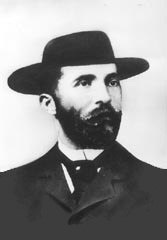 I mean, check out
"Soapy" Smith at left, the 19th-century con man who gained national
notoriety for selling soap just as I've described above. What a hunk,
right? He's probably really clean, too.
I mean, check out
"Soapy" Smith at left, the 19th-century con man who gained national
notoriety for selling soap just as I've described above. What a hunk,
right? He's probably really clean, too.
...OK, maybe ol' Soap isn't the best example.
Seriously though, just think of the number of movies and books featuring conning as a motif, if not the core, of the work. Neil Gaiman's American Gods; Frank Oz's Dirty Rotten Scoundrels; Spielberg's Catch Me If You Can, based off the real-life cons of Frank Abagnale, Jr.; Eric Garcia's Matchstick Men and Rian Johnson's The Brothers Bloom all spring to mind. Let's not forget the number of movies featuring Paul Newman and Robert Redford as the dashing outlaws or swindlers you can't help but love. Moreover, we're following the story from the con men's perspective more often than not. It's almost as if we're...glorifying them.
Steal our hearts too, whydontcha.
'Til next time, logophiles.
Information purloined from dictionary.reference.com, Britannica Academic Edition, British Bankers' Association, The New York Times and The Lost Museum at CUNY; image purloined from Wikimedia Commons
* : Chanel's new fragrance, Eau du Locker Room -- At Least You Don't Smell Like Feet™
(Also, check out a previous entry I have on quack remedies, called nostrums)
** : Note I am not singling out the Greeks. There are gullible people ripe for swindling in every land and culture. But if I were singling out the Greeks, hey, they don't call him Jason "The Golden Fleece" d'Argos for nothing
*** : "Dude, 50 denarii! We be rollin' in mutton, yo"
Today's entry is about the guy who calls elderly folks and promises in honeyed tones that they've won a sweepstakes, if they would only forward him some money to pay the cost of sending them their winnings. It's about the street vendor claiming that his tonic water changes sweat into a perfume irresistible to the opposite sex.*
We're talking mountebanks, racketeers and snake-oil salesmen -- better known as "con artists." But do you know where the "con" part comes from?
If you think it's related to the con part in "ex-con," guess again -- the latter is a shortened form of "ex-convict." (Though if given enough time one might become the other.)
"Con man" is an abbreviation of "confidence man," named for the way such a crook swindles people not only out of their money, but also their trust. The term originated with the serial watch-thief William Thompson who, after chatting with his intended victim, would ask him or her, "Have you confidence in me to trust me with your watch until tomorrow?" The victim, called a "mark," would hand Thompson his or her watch, and the thief whom the New York Herald dubbed the "Confidence Man" walked off with a shiny bit of clockwork to sell. Thompson was arrested in 1849, but his nickname stuck, and soon came to describe all sorts of thieves and the confidence games (American English) or confidence tricks (British English) they plied in 19th-century New York.
Though people have been bilking each other for probably as long as currency has existed, 19th-century America was a particularly fertile seedbed for confidence games and words coined about them:
- According to dictionary.reference.com, the terms "con man", "confidence game" and the verb "con" all entered American English in the mid-19th century.
- The Spanish Prisoner game has hornswoggled people since at least the 1860s, according to the New York Times. The swindle originally entailed the con artist claiming to be in contact with a wealthy political prisoner incarcerated in Spain. The con artist offered to let the mark provide some of the funds required to secure the prisoner's release in exchange for a larger reward later from the wealthy prisoner. Of course, the mark never received this reward. This con survives in the modern day as advance-fee fraud.
- The term "goldbrick," all one word, also emerged from the mid-1800s to describe a bar of heavy, base metal, usually lead, gilded to resemble solid gold and sold as such. The word has since gained new life as a verb, meaning to shirk responsibility, perform something halfheartedly, or to loaf (dictionary.reference.com).
- The shell game has existed since Ancient Greeks first used it to swipe each other's cold, hard drachma,** but the term first appeared as an Americanism in the 1880s, referring to the nutshells and pea used instead of the typical three cups and ball (pictured in Hieronymus Bosch's "The Conjurer"; note the con artist's accomplice swiping the player's coinpurse on the left-hand side).***
While conning involves a fair bit of prop use and often sleight-of-hand, the crux of a confidence game is always emotional manipulation. That's why stories about cons are as commonplace as a penny on the sidewalk. As much as we'd like to believe ourselves skeptical and perceptive enough to spot a crooked deal, we're only human. We want to believe the armchair we bought at the garage sale is worth the millions the "appraiser" says it is, so we pay her an advance fee to ensure the chair fetches a good price at auction. Never mind that we've never heard of Whitcombe-Whipple's Disease -- we fork over a few bills to the sharp-dressed man collecting money for it because we want to believe we're good people. And why advertise that there's $100 in one of these soap bar packages unless there is one there? Surely not to just sell soap! Why, that would be...a very effective way to sell soap.
Oh.
Therein lies the problem. Con artists, they're a two-cans-of-hair-gel kind of smooth. They trick us into believing that they're just like us by working on what makes us human -- our faith in each other -- and worst of all, they look good doing it.
I mean, check out
"Soapy" Smith at left, the 19th-century con man who gained national
notoriety for selling soap just as I've described above. What a hunk,
right? He's probably really clean, too....OK, maybe ol' Soap isn't the best example.
Seriously though, just think of the number of movies and books featuring conning as a motif, if not the core, of the work. Neil Gaiman's American Gods; Frank Oz's Dirty Rotten Scoundrels; Spielberg's Catch Me If You Can, based off the real-life cons of Frank Abagnale, Jr.; Eric Garcia's Matchstick Men and Rian Johnson's The Brothers Bloom all spring to mind. Let's not forget the number of movies featuring Paul Newman and Robert Redford as the dashing outlaws or swindlers you can't help but love. Moreover, we're following the story from the con men's perspective more often than not. It's almost as if we're...glorifying them.
Steal our hearts too, whydontcha.
'Til next time, logophiles.
Information purloined from dictionary.reference.com, Britannica Academic Edition, British Bankers' Association, The New York Times and The Lost Museum at CUNY; image purloined from Wikimedia Commons
* : Chanel's new fragrance, Eau du Locker Room -- At Least You Don't Smell Like Feet™
(Also, check out a previous entry I have on quack remedies, called nostrums)
** : Note I am not singling out the Greeks. There are gullible people ripe for swindling in every land and culture. But if I were singling out the Greeks, hey, they don't call him Jason "The Golden Fleece" d'Argos for nothing
*** : "Dude, 50 denarii! We be rollin' in mutton, yo"
Subscribe to:
Posts (Atom)