Hey loyal readers - just wanted to let you know that I haven't been posting for a very important reason. I'm working on a project for this blog - a slideshow of photographs depicting idioms acted out by real, live people!*
If you'd like to be part of this project and live in the Gainesville, Fla. area, feel free to e-mail me at edwardmbowen@gmail.com and we can set up a time to get you in a photo before Friday.
Thanks folks! I'll have this slideshow up and running on here by Friday at the latest.
- Mead
* - as opposed to fake, dead people**
** - poking fun at my own redundancies
Tuesday, July 21, 2009

Wednesday, July 15, 2009
When screened-in porches just won't do
For every cricket in existence, technology owns a bug itself. Tech support operators equal, if not exceed, the number of exterminators on the planet (ducks and bats and the like not included). Malfunctioning machines and insects are so numerous, and so akin - they buzz, hum, annoy and require monthly maintenance to prevent - that at times they just beg you to open the window and let them out.
With that in mind, the subject of today's blog proceeds accordingly:
the word "defenestrate."
Hehehehe...had you going there, didn't I?
The word "defenestrate" originated in the early 1600s* and comes from the root "fenestra," Latin for window. Parsed up into de/fenestrate, it means in this case out of/window - literally, "the act of throwing something, or especially someone, out of a window."
Probably the most famous defenestrations in history were the First and Second Defenestrations of Prague. Even if you were an attentive scholar, you probably thought there was only one famous Czech window-toss.**
Though it wasn't called a defenestration until its successor made history, the First Defenestration of Prague occurred on July 30, 1419. It began with the march of an armed congregation of Czech Hussites through the streets of Prague, protesting the imprisonment of several of their fellows. They marched to the New Town Hall, where the Catholic councilors refused to even make a prisoner exchange.
That's when an Anti-Hussite had the bright idea of throwing a rock*** at one of the protesters.
What goes up must come down. Several of the crowd stormed the New Town Hall and all seven of the councilors came down, through the window and onto the upright spears of the protesters below.
For the Protestants in 1618 who had heard of this former triumph, the preliminaries to the Second Defenestration must have seemed déjà vu. In 1617, Roman Catholic bigwigs ordered builders to abandon construction of several Protestant churches on allegedly Church-owned land. The Protestants claimed it belonged to the king and was, therefore, theirs upon which to build. They treated this development as the denial of a basic right, and feared the denial of other rights for Protestants was soon to follow.
After a few meetings, the riled non-Catholic nobility barged into the Bohemian Chancellery at Prague Castle. The crowd tried two despised governors, both staunchly Catholic and notorious persecutors of Protestants, for violating the Right of Freedom of Religion.****
Old habits die hard, and amid cheers and shattered glass, the convicted and their scribe plummeted 16 meters (that's 52.5 feet, folks) to the ground.

The governors and scribe fell not onto skull-cracking cobblestones, but - some said providentially, others said coincidentally - onto a large pile of manure, and thereby survived the drop unscathed.
Though punished capitally for such high-rise aristicide, Czech Protestants certainly knew how to make an exit.
Comic book fans might remember another notable defenestration, given the recent movie adaptation of the timeless series: Watchmen. While the movie's version isn't quite true to that of the book, it's nonetheless impressive.
Even more impressive: a reverse defenestration, courtesy of Chuck Norris.
So remember, kids, if you ever get kidnapped and held for questioning under pain of death by Czech hypernationalists who despise everything your c0untry stands for, there are worse ways to die. And luckily, it doesn't always work!*****
Information purloined from dictionary.com, New World Encyclopedia, OnlineConversion.com; picture purloined from Wikimedia Commons
* - though arguably if this part of the Old Testament is true, Jezebel might've been the first
** - Unless you count when the Scottish ambassador challenged the king to a cathedral caber-toss
*** - Or petrojected (petro = rock/ject = to throw) at one of the protesters!******
**** - And we're not taking a cue from the Czechs about punishment for First Amendment violators because...?
***** - Defenestration into a railroad spike factory Dumpster greatly diminishes the likelihood of survival
****** - seeing as I only wish this word existed, I do not endorse its use in Scrabble
With that in mind, the subject of today's blog proceeds accordingly:
the word "defenestrate."
Hehehehe...had you going there, didn't I?
The word "defenestrate" originated in the early 1600s* and comes from the root "fenestra," Latin for window. Parsed up into de/fenestrate, it means in this case out of/window - literally, "the act of throwing something, or especially someone, out of a window."
Probably the most famous defenestrations in history were the First and Second Defenestrations of Prague. Even if you were an attentive scholar, you probably thought there was only one famous Czech window-toss.**
Though it wasn't called a defenestration until its successor made history, the First Defenestration of Prague occurred on July 30, 1419. It began with the march of an armed congregation of Czech Hussites through the streets of Prague, protesting the imprisonment of several of their fellows. They marched to the New Town Hall, where the Catholic councilors refused to even make a prisoner exchange.
That's when an Anti-Hussite had the bright idea of throwing a rock*** at one of the protesters.
What goes up must come down. Several of the crowd stormed the New Town Hall and all seven of the councilors came down, through the window and onto the upright spears of the protesters below.
For the Protestants in 1618 who had heard of this former triumph, the preliminaries to the Second Defenestration must have seemed déjà vu. In 1617, Roman Catholic bigwigs ordered builders to abandon construction of several Protestant churches on allegedly Church-owned land. The Protestants claimed it belonged to the king and was, therefore, theirs upon which to build. They treated this development as the denial of a basic right, and feared the denial of other rights for Protestants was soon to follow.
After a few meetings, the riled non-Catholic nobility barged into the Bohemian Chancellery at Prague Castle. The crowd tried two despised governors, both staunchly Catholic and notorious persecutors of Protestants, for violating the Right of Freedom of Religion.****
Old habits die hard, and amid cheers and shattered glass, the convicted and their scribe plummeted 16 meters (that's 52.5 feet, folks) to the ground.
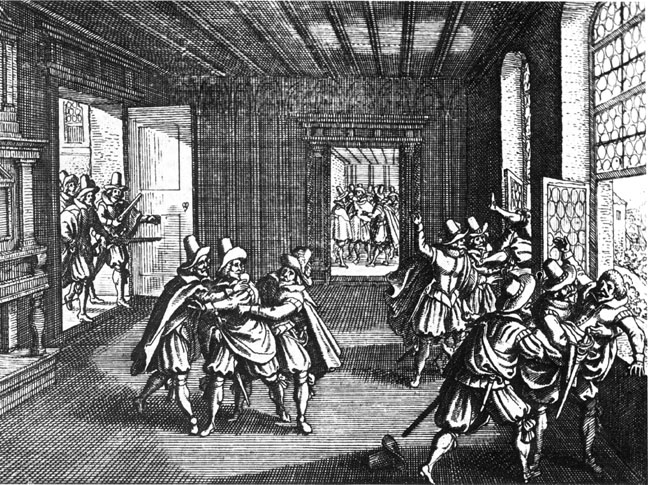
The governors and scribe fell not onto skull-cracking cobblestones, but - some said providentially, others said coincidentally - onto a large pile of manure, and thereby survived the drop unscathed.
Though punished capitally for such high-rise aristicide, Czech Protestants certainly knew how to make an exit.
Comic book fans might remember another notable defenestration, given the recent movie adaptation of the timeless series: Watchmen. While the movie's version isn't quite true to that of the book, it's nonetheless impressive.
Even more impressive: a reverse defenestration, courtesy of Chuck Norris.
So remember, kids, if you ever get kidnapped and held for questioning under pain of death by Czech hypernationalists who despise everything your c0untry stands for, there are worse ways to die. And luckily, it doesn't always work!*****
Information purloined from dictionary.com, New World Encyclopedia, OnlineConversion.com; picture purloined from Wikimedia Commons

* - though arguably if this part of the Old Testament is true, Jezebel might've been the first
** - Unless you count when the Scottish ambassador challenged the king to a cathedral caber-toss
*** - Or petrojected (petro = rock/ject = to throw) at one of the protesters!******
**** - And we're not taking a cue from the Czechs about punishment for First Amendment violators because...?
***** - Defenestration into a railroad spike factory Dumpster greatly diminishes the likelihood of survival
****** - seeing as I only wish this word existed, I do not endorse its use in Scrabble
Sunday, July 12, 2009
"Give 'im a taste of the boatswain's rope-end, early in the morning!"
 One of the prerequisites for sons of veterinarians is an appreciation for animals. I've owned cats all my life, and my parents adopted a rescue dog several years ago, with whom I promptly fell in love. The photo at the left is of me and said dog, Maggie.
Let's make it clear that I'm an equal-opportunity zoophile (ZU-oh-fyle; and not of the sexual kind, smartalecks) before I make an entry for this misunderstood idiom, because
1) I am neither a strict cat person nor a strict dog person
2) I dislike cruelty to animals as much as the next person
3) my father might disown me if he thought otherwise*
With that said, today's entry is a seafaring phrase (notice a pattern?) reviled for its presumed association to animal cruelty: enough room to swing a cat.
The "cat" in this phrase refers to a nasty whip known as a cat o' nine tails, used to punish lawbreaking sailors in the British Royal Navy until the 1800s. This flogging occurred on deck in full view, because below deck the ceilings were too low for the boatswain's (pronounced BO-sun's) mate to swing the whip.
Though other variations existed, the naval cat was made out of rope. Colonial-era rope was made of three thin ropes, each composed of three strands of cotton yarn - when unraveled at the end, nine separate strings would result, giving the whip its nine tails.**
 The jury is out on whether they were usually knotted, but most accounts maintain they were. Each would cause intense pain when striping an insubordinate's back. If the crime was theft, the mate would employ the thieves' cat, each of its thongs knotted three times for additional pain (see right). Theft was an especially serious crime aboard a naval vessel.***
Several regulations about usage of the whip existed, but as we innovative humans often do, captains found ways to circumvent them. Though floggings exceeding 12 lashes were subject to court martial, captains often got away with as many as 72 without being caught. The mate put all of his strength into each blow, and if the captain decreed more lashes, another man would deliver the next set of 12 to ensure the punishment's severity.
The song "What Shall We Do with a Drunken Sailor" features a pseudonym for the cat, "the captain's daughter," seeing as in theory the cat was used only with his permission. Whether your version of the song says "give him a taste of the captain's daughter" or "put him in the bed with the captain's daughter," the singers are asking for a flogging.****
That the song requests this punishment doesn't surprise me. Punishment in British, colonial and piratical societies alike was public spectacle. People treated hangings and clapping a criminal in stocks as we might a free benefit concert or a fistfight in the schoolyard.
Nowadays, the use of the cat tends to be a private matter, as any BDSM devotee will discreetly***** tell you. Funny how what was once punishment, some of us today do voluntarily. Maybe some royal sailors deliberately violated the law? Who knows. What I do know is that where our contemporaries want to swing the cat, there's always [a] room [in which] to do it.
Information purloined from Captain Blood's Cove, Broadside, pride-unlimited.com, Pirates of the Caribbean: A Pyrate's Life, dictionary.reference.com; images purloined from Wikimedia Commons and my personal album

* - I may or may not have once fed Maggie a Jujube to point and laugh at her (and I'm kidding about that disownment part)
** - Any thoughts on why people have said cats have nine lives, besides surviving falls from great heights?
*** - one flaskful of liquor smuggled aboard could buy a lot of hardtack - we're talking, like, a 1:5 ratio here******
**** - if you were lucky, maybe even from the captain's daughter*******
***** - or vocally and in graphic detail
****** - What? It works as a deadly projectile if you don't have a rock...
******* - Before anybody gets excited about the further possibility for pirate pornography - yes, there is already a multimillion-dollar two-part series - bringing a woman or young boy aboard was punishable by death.
![Reblog this post [with Zemanta]](https://lh3.googleusercontent.com/blogger_img_proxy/AEn0k_sbZ70V-f7yrmPjv47aHanCMslGnBWfoMsP8ut1IjrTibGcpJTw71_SIpvt5kBVPEce67s4jiKtqyO0_Vy3P6VnoK7HBCTowZFcfMZXia_qChXV2LL8eV84hBBzRsv86XJgH42nKr0lzrzbcKk9XDI=s0-d)
Saturday, July 11, 2009
Mead's Online Guide to Using Insults and Escaping While Your Victim Consults a Dictionary
Certain words emerge to represent personalities that serve as fixtures in the community. Scapegoats and sin-eaters bear the guilt for everyone else's trangressions; the gossipmonger collects the tawdry activities of the neighborhood and serializes them; the voyeur enjoys the thrill of watching private moments through a windowpane.
Come to think of it, none of these are positive, are they?
Today's entry is no exception, I'm afraid: it covers one of my favorite words, "curmudgeon." A curmudgeon is defined by dictionary.com as "a bad-tempered, difficult, cantankerous person."
Though the origin is unknown, I'm casting my vote with Walter William Skeat (1835 - 1912), author of several tracts on the English language. He maintained that curmudgeon is a combination of the English word "cur" (a mongrel dog, especially a worthless or unfriendly one) and one of two Lowland Scottish words: "mudgeon" (grimace) or "murgeon" (to mock; to grumble).
Strangely, in modern English dictionaries "murgeon" instead refers to grimace, whereas "mudgeon" isn't listed. "Ker" is also used in a variety of words as a prefix for greater emphasis in onomateopoeic words liked "kerplunk."* I do hope Sherlock Holmes can shed some light on this mystery.
Either way, the word literally translates to "an unfriendly, grimacing/grumbling mongrel dog." Better use this one sparingly, folks.**

Literary curmudgeons include A Christmas Carol's Ebenezer Scrooge, the Harry Potter series's Severus Snape, and To Kill a Mockingbird's morphine-addicted Mrs. Dubose.
Dr. Gregory House of the namesake show has also been labeled as such.
The curmudgeon who comes to my mind is the movie Steel Magnolias's Ousier Boudreaux (as if that it's pronounced "wheezer" isn't clue enough), the laughingstock of her friends with a kinder heart than she tends to show (farthest left in picture).
As literature and movies demonstrate, people are rarely curmudgeons for the sake of being curmudgeonly. Regret, pain or disillusionment gnaws at their roots, souring their moods. But Scrooge's heart thaws when faced with his own mortality, Mrs. Dubose sends a single white camelia to the Finch children as thanks for reading to her, and Ouiser's love for children shows in the smile she gives her friend's son.***
I don't know about House, because I don't watch "House," and if you need a reason why I don't watch "House," you're staring at it.
I suppose that makes me a curmudgeon, too?
I prefer to use the term "selectively cranky."
Information purloined from dictionary.com, the Oxford University Press Blog, and The Mavens' Word of the Day; image purloined from The International Movie Database
* - such as our word's comic-book cousin, KERBLUDGEON!
** - limit usage to your ancient in-laws who never really liked you, and who run about as fast as you can walk
*** - before he bursts into tears
Come to think of it, none of these are positive, are they?
Today's entry is no exception, I'm afraid: it covers one of my favorite words, "curmudgeon." A curmudgeon is defined by dictionary.com as "a bad-tempered, difficult, cantankerous person."
Though the origin is unknown, I'm casting my vote with Walter William Skeat (1835 - 1912), author of several tracts on the English language. He maintained that curmudgeon is a combination of the English word "cur" (a mongrel dog, especially a worthless or unfriendly one) and one of two Lowland Scottish words: "mudgeon" (grimace) or "murgeon" (to mock; to grumble).
Strangely, in modern English dictionaries "murgeon" instead refers to grimace, whereas "mudgeon" isn't listed. "Ker" is also used in a variety of words as a prefix for greater emphasis in onomateopoeic words liked "kerplunk."* I do hope Sherlock Holmes can shed some light on this mystery.
Either way, the word literally translates to "an unfriendly, grimacing/grumbling mongrel dog." Better use this one sparingly, folks.**

Literary curmudgeons include A Christmas Carol's Ebenezer Scrooge, the Harry Potter series's Severus Snape, and To Kill a Mockingbird's morphine-addicted Mrs. Dubose.
Dr. Gregory House of the namesake show has also been labeled as such.
The curmudgeon who comes to my mind is the movie Steel Magnolias's Ousier Boudreaux (as if that it's pronounced "wheezer" isn't clue enough), the laughingstock of her friends with a kinder heart than she tends to show (farthest left in picture).
As literature and movies demonstrate, people are rarely curmudgeons for the sake of being curmudgeonly. Regret, pain or disillusionment gnaws at their roots, souring their moods. But Scrooge's heart thaws when faced with his own mortality, Mrs. Dubose sends a single white camelia to the Finch children as thanks for reading to her, and Ouiser's love for children shows in the smile she gives her friend's son.***
I don't know about House, because I don't watch "House," and if you need a reason why I don't watch "House," you're staring at it.
I suppose that makes me a curmudgeon, too?
I prefer to use the term "selectively cranky."
Information purloined from dictionary.com, the Oxford University Press Blog, and The Mavens' Word of the Day; image purloined from The International Movie Database
* - such as our word's comic-book cousin, KERBLUDGEON!
** - limit usage to your ancient in-laws who never really liked you, and who run about as fast as you can walk
*** - before he bursts into tears
Friday, July 10, 2009
When the saints go marching in
Do you ever have the wish that life was more like a play, or a video game, or a musical - someplace where a higher power can swoop in from above and rectify all of your problems?
Well, NOW YOU CAN - sorry, couldn't resist the temptation. I blame infomercials.
In any case, this blog will cover a literary device for which all literature buffs have the utmost contempt: the deus ex machina.
The Latin phrase (literally, God from the machine) is a translation from the original Greek, where it referred to the mechane, a device in ancient Greek theatre used to lower the actors playing the gods as if they were descending from Mt. Olympus. The gods functioned in the play as a means of resolving the plot or rescuing the protagonist from a particularly sticky situation, like some archaic Staples easy button.*
Let's not forget that divine intervention, however, doesn't lend a play any more substance.
Even ancient Greeks were critical of the mechane; in his play Thesmophoriazusae (Women Celebrating the Thesmophorae, the Thesmophorae being an annual fertility celebration held in honor of fertility goddess Demeter), Aristophanes makes fun of Euripides for overusing the convention. In the play, Euripides swoops in on the mechane in attempt to save his kinsman from harm when he is discovered spying for him at the females-only rite.**
 Today, the deus ex machina refers to a device abhorred by every self-respecting literary buff - a tidy, but improbable and ultimately unsatisfying resolution.
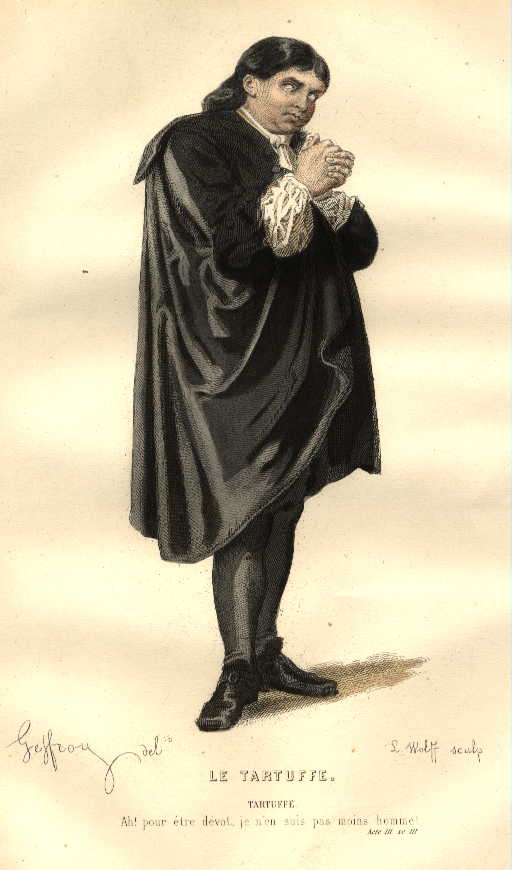
My first encounter with the concept was a reading of Moliére's Tartuffe, or the Hypocrite (title character at right), where King Louis XIV sends an officer in the nick of time to arrest the impostor Tartuffe, to restore the house Tartuffe had swindled and blackmailed out of the family, and to announce the wedding of the play's young lovers - all the space of a few lines.
The convention is not something that disappeared with time and can today generally be chalked up to the laziness of the author. Modern versions include cavalry riding over the hill to the rescue, the villain's sudden death from cardiac arrest or - the particular brew of "God from the machine" that I love to hate - the protagonist waking to find it was all a bad dream.***
We call them cheat codes in video games for a reason.
In other news, a student's recent twist on the motorcycle made the list of search results, though I can't say any implications of divinity in its machinery look promising. And if the deus in question is the driver of the motorcycle, doesn't labeling a human "God" defy and defeat the purpose of godhood anyway?
Information purloined from The Phrase Finder, Statemaster.com; image purloined from idlemindproductions.com
* - "and Hephaestus heard the pleas of the bureaucrats, and paper clips rained from the heavens"
** - Subtext: crashing a goddess's charity function might kill you
*** - or a bad trip, if you fell down a rabbit hole
![Reblog this post [with Zemanta]](https://lh3.googleusercontent.com/blogger_img_proxy/AEn0k_sX9z0DlLexDVI1E2uUEjTVeE08xu_69YEBttgLQasD5OrzDF838SxIchz9vNNzmSh2MXEC18AAw4YNsXdJfQZlk-lWlb7JXyrQAUB_82cKUsKJk1qTcTDy20q-mcyTtTvtdkOvoFbO-1k_KEGrgDn6=s0-d)
Well, NOW YOU CAN - sorry, couldn't resist the temptation. I blame infomercials.
In any case, this blog will cover a literary device for which all literature buffs have the utmost contempt: the deus ex machina.
The Latin phrase (literally, God from the machine) is a translation from the original Greek, where it referred to the mechane, a device in ancient Greek theatre used to lower the actors playing the gods as if they were descending from Mt. Olympus. The gods functioned in the play as a means of resolving the plot or rescuing the protagonist from a particularly sticky situation, like some archaic Staples easy button.*
Let's not forget that divine intervention, however, doesn't lend a play any more substance.
Even ancient Greeks were critical of the mechane; in his play Thesmophoriazusae (Women Celebrating the Thesmophorae, the Thesmophorae being an annual fertility celebration held in honor of fertility goddess Demeter), Aristophanes makes fun of Euripides for overusing the convention. In the play, Euripides swoops in on the mechane in attempt to save his kinsman from harm when he is discovered spying for him at the females-only rite.**
 Today, the deus ex machina refers to a device abhorred by every self-respecting literary buff - a tidy, but improbable and ultimately unsatisfying resolution.
My first encounter with the concept was a reading of Moliére's Tartuffe, or the Hypocrite (title character at right), where King Louis XIV sends an officer in the nick of time to arrest the impostor Tartuffe, to restore the house Tartuffe had swindled and blackmailed out of the family, and to announce the wedding of the play's young lovers - all the space of a few lines.
The convention is not something that disappeared with time and can today generally be chalked up to the laziness of the author. Modern versions include cavalry riding over the hill to the rescue, the villain's sudden death from cardiac arrest or - the particular brew of "God from the machine" that I love to hate - the protagonist waking to find it was all a bad dream.***
We call them cheat codes in video games for a reason.
In other news, a student's recent twist on the motorcycle made the list of search results, though I can't say any implications of divinity in its machinery look promising. And if the deus in question is the driver of the motorcycle, doesn't labeling a human "God" defy and defeat the purpose of godhood anyway?
Information purloined from The Phrase Finder, Statemaster.com; image purloined from idlemindproductions.com
* - "and Hephaestus heard the pleas of the bureaucrats, and paper clips rained from the heavens"
** - Subtext: crashing a goddess's charity function might kill you
*** - or a bad trip, if you fell down a rabbit hole
Puddle, puddle, po-puddle, banana-fana-fo-fuddle, me-my-mo-______
More blog entries forthcoming. Really need to get back on schedule with this thing.
Today's entry is on a versatile word applicable in the realms of the culinary, the artistic and the quotidian, or everyday - which, if improperly used, could do just what this word means: muddle.
The root of muddle is the Middle Dutch verb "moddelen," meaning "to muddy." Soil, besmirch, dirt-encrust - yes, these all are correct - but muddle's commonest meanings are "to mix up or confuse in a bungling manner" and "to mentally confuse."
My first encounter with the word came from playing a video game, Harvest Moon 64. I romanced the rancher girl on the game and, when she fell in love with the hat-clad studmuffin protagonist, the fiery redhead said:

"I like you. Does that muddle things up?"
My character said "no," to which she responded, "Well, then what are you waiting for?"
He went in the for the kiss and she promptly slapped him, saying, "Not that, stupid! The blue feather," the feather being the game's version of a wedding ring. I was left to ponder this exchange, and to discover my newfound word. See, video games aren't useless. They teach you vocabulary!*
Type "muddle" into an ad-sponsored dictionary and you'll get mojito recipes on the side. That's because muddling also refers to crushing or mashing ingredients into one another, a technique used in cooking and bartending. The process makes use of a spoon or, if you have one, a muddler (a rod with a flattened end) to crush the ingredients. The infamous mint julep requires a bartender to muddle mint and sugar inside the serving glass.
 |
| Image from Wikipedia |

Too many mint juleps might muddle you - muddle also means "to confuse or stupefy with, or as if with, an intoxicating drink."**
If you check American online news with frequency, you might have noticed every politician, journalist and economic analyst using the phrase "muddle through." Though used about subjects ranging from U.S. policy in Afghanistan to the banking crises, the meaning is the same: "to achieve a certain degree of success but without much skill, polish, experience, or direction."
To just plain muddle is "to behave, proceed or think in a confused or aimless fashion, or with an air of improvisation."
Which, if either, is fitting, I'll leave for you to decide.
Psst! Here's a recipe for "The Genuine Cuban Mojito," courtesy of The Bodeguita del Medio in Cuba:
Ingredients
2 tsp sugar
Juice from 1/2 lime
2 mint sprigs
2 parts sparkling water
1 part rum
4 ice cubes
Add the ingredients to a glass, preferably a cylindrical one, in the order above, reserving the rum. Muddle in the glass. Add the rum, followed by the ice cubes. Enjoy!
Information purloined from dictionary.com; image purloined from Wikipedia
* - and that even if you're a self-made man who saves a farm from the brink of extinction and who courts his lady with all the propriety and gentility she is due, you will still be a thoughtless cad
** - in Soviet Russia, drinks muddle YOU!

![Reblog this post [with Zemanta]](https://lh3.googleusercontent.com/blogger_img_proxy/AEn0k_strCUCy4-y_3wvY3uuEtQyqI9F6wkO8vEQetxNOmiYwJgw5FxblKVn45oDXqUdTOYb3NtPOIktC9iVhTq5yepngEi6S7D3E5W-_onn7l5IjFUD2zcLKzGZ7kLlXmMkXGahFoS69Yhtj1WTM7M26gQ6=s0-d)
Tuesday, July 7, 2009
The incantation continues...
Sorry for not posting - again - on my regularly scheduled days. I drove down to Maitland (near Orlando, for those for whom the name rings no bell), Fla., for the Fourth of July. My parents' house had no Internet access and my parents enlisted my help in Independence Day preparations. I'll write compensatory posts sometime this week.
Something you all might find interesting:
My girlfriend and I attempted to make a piña colada pancake last Wednesday. The recipe we used was for an oven pancake, meaning that the chef puts the pancake, pan and all, into the oven to cook it. As I was putting in the pan, I told myself that it would be hot when we finished it. Nonetheless, when my beloved removed it from the oven, she remarked on its appearance, and so I moseyed over, and with a reckless, "Really? Let me see," grabbed the scalding pan.
The resultant burn hurt so badly that I had to sit at home with my hand in ice water during my Political Science class. Once I looked at my hand, however, I noticed that the burn skipped over the lifeline.
When people seeing the burn-mark ask me about it, I say, "I guess it means I have a charmed life."
Hence, my blog entry.
The saying "a charmed life" comes again from our beloved playwright, William Shakespeare, in his infamous play Macbeth. The phrase occurs in line 16 of the play when Macbeth, complacent in the Weird Sisters' prediction that he shall not die at the hand of anyone born of a woman, taunts his opponent, Macduff (lines 12-17):
Or, translated for your convenience:
 Perhaps Shakespeare was also progenitor of the loophole; Macduff reveals three lines later that C-section babies don't count, and takes Macbeth's smug pate as a trophy. One would think moving forests would be enough to make the man a skeptic.
The true lesson of this play is that no man or woman can escape destiny. The Weird Sisters definitely live up to their name here. Shakespeare knew his mythology, as I'm about to explain. Yes, ladies and gents, a 2-for-1 entry. And it's not even happy hour!**
In Anglo-Saxon mythology, the goddess of Fate, also known as "the Lord of every man," bears the name "Wyrd" - a word also used as a noun to refer to one's fate or destiny itself. Chaucer in Troilus and Criseyde christens Fortune "executrice of wierdes" (executress of destinies; Book III, line 617), and writes in The Legend of Good Women of "The Wirdes, that we clepen [call] Destinee" (Book IX, line 19).
Holinshed's Chronicles of England, Scotland, and Ireland (1577), however, was Shakespeare's source material for Macbeth. Shakespeare adapted the scene and dialogue of Macbeth and Banquo's first meeting with the Weird Sisters straight from this text, in which they are the Norns, or Sister-Fates, of Norse mythology: Urthr, the Past; Verthandi, the Present; and Skuld, the Future.
We have since demoted the word "weird" to the shame of "fantastic, bizarre" or "suggestive of the supernatural." I don't imagine Lady (or the Ladies) Wyrd are pleased. If we aren't careful, they might call in a favor with their Greek sisters****, Clotho, Lachesis and Atropos, to gang up on us. Those shears can be vicious, and I don't imagine they're cleaned very often.
Information purloined from The Phrase Finder, Theatre Database and william-shakespeare.info
* - one of Shakespeare's brilliant additions to the English language. If you must split hairs, intrenchant really means "not to be gashed or marked with furrows (or trenches)"
** - unless, by the time you read this entry, it is between 4 p.m. and 7 p.m.***
*** - unless, by the time you read this entry, you are in Ireland
**** - from the Mt. Olympus chapter of the Global Fateweaving Vocational Sorority
![Reblog this post [with Zemanta]](https://lh3.googleusercontent.com/blogger_img_proxy/AEn0k_uU3m1JVt9-ohka9ez9dV1mIx4ykSlWeINKZRk3bRs4WlRQkaXP2cTcL16EGJOZTTWFj6q25UCDLH0DeofwdihqZdFPwbnM8mQWW1vE8xn9NqiG6UaeDHSyCedHKzTVE8wr6Ch24Gj6w5r47dICf5Y=s0-d)
Something you all might find interesting:
My girlfriend and I attempted to make a piña colada pancake last Wednesday. The recipe we used was for an oven pancake, meaning that the chef puts the pancake, pan and all, into the oven to cook it. As I was putting in the pan, I told myself that it would be hot when we finished it. Nonetheless, when my beloved removed it from the oven, she remarked on its appearance, and so I moseyed over, and with a reckless, "Really? Let me see," grabbed the scalding pan.
The resultant burn hurt so badly that I had to sit at home with my hand in ice water during my Political Science class. Once I looked at my hand, however, I noticed that the burn skipped over the lifeline.
When people seeing the burn-mark ask me about it, I say, "I guess it means I have a charmed life."
Hence, my blog entry.
The saying "a charmed life" comes again from our beloved playwright, William Shakespeare, in his infamous play Macbeth. The phrase occurs in line 16 of the play when Macbeth, complacent in the Weird Sisters' prediction that he shall not die at the hand of anyone born of a woman, taunts his opponent, Macduff (lines 12-17):
MACBETH
Thou losest labour:
As easy mayst thou the intrenchant* air
With thy keen sword impress as make me bleed:
Let fall thy blade on vulnerable crests;
I bear a charmed life, which must not yield,
To one of woman born.
Or, translated for your convenience:
Your attempts are in vain;
It is as easy for you to wound the invincible air as it is for you to wound me.
Swing at the shields/helmets/necks of the vulnerable;
Magic charms protect me, and no one born of a woman shall kill me.
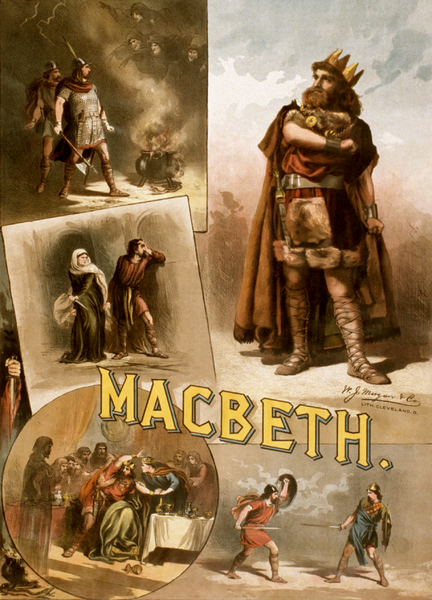 Perhaps Shakespeare was also progenitor of the loophole; Macduff reveals three lines later that C-section babies don't count, and takes Macbeth's smug pate as a trophy. One would think moving forests would be enough to make the man a skeptic.
The true lesson of this play is that no man or woman can escape destiny. The Weird Sisters definitely live up to their name here. Shakespeare knew his mythology, as I'm about to explain. Yes, ladies and gents, a 2-for-1 entry. And it's not even happy hour!**
In Anglo-Saxon mythology, the goddess of Fate, also known as "the Lord of every man," bears the name "Wyrd" - a word also used as a noun to refer to one's fate or destiny itself. Chaucer in Troilus and Criseyde christens Fortune "executrice of wierdes" (executress of destinies; Book III, line 617), and writes in The Legend of Good Women of "The Wirdes, that we clepen [call] Destinee" (Book IX, line 19).
Holinshed's Chronicles of England, Scotland, and Ireland (1577), however, was Shakespeare's source material for Macbeth. Shakespeare adapted the scene and dialogue of Macbeth and Banquo's first meeting with the Weird Sisters straight from this text, in which they are the Norns, or Sister-Fates, of Norse mythology: Urthr, the Past; Verthandi, the Present; and Skuld, the Future.
We have since demoted the word "weird" to the shame of "fantastic, bizarre" or "suggestive of the supernatural." I don't imagine Lady (or the Ladies) Wyrd are pleased. If we aren't careful, they might call in a favor with their Greek sisters****, Clotho, Lachesis and Atropos, to gang up on us. Those shears can be vicious, and I don't imagine they're cleaned very often.
Information purloined from The Phrase Finder, Theatre Database and william-shakespeare.info
* - one of Shakespeare's brilliant additions to the English language. If you must split hairs, intrenchant really means "not to be gashed or marked with furrows (or trenches)"
** - unless, by the time you read this entry, it is between 4 p.m. and 7 p.m.***
*** - unless, by the time you read this entry, you are in Ireland
**** - from the Mt. Olympus chapter of the Global Fateweaving Vocational Sorority
Subscribe to:
Posts (Atom)