Showing posts with label word origin. Show all posts

Wednesday, July 15, 2009

When screened-in porches just won't do

For every cricket in existence, technology owns a bug itself. Tech support operators equal, if not exceed, the number of exterminators on the planet (ducks and bats and the like not included). Malfunctioning machines and insects are so numerous, and so akin - they buzz, hum, annoy and require monthly maintenance to prevent - that at times they just beg you to open the window and let them out.

With that in mind, the subject of today's blog proceeds accordingly:

the word "defenestrate."


Hehehehe...had you going there, didn't I?

The word "defenestrate" originated in the early 1600s* and comes from the root "fenestra," Latin for window. Parsed up into de/fenestrate, it means in this case out of/window - literally, "the act of throwing something, or especially someone, out of a window."

Probably the most famous defenestrations in history were the First and Second Defenestrations of Prague. Even if you were an attentive scholar, you probably thought there was only one famous Czech window-toss.**

Though it wasn't called a defenestration until its successor made history, the First Defenestration of Prague occurred on July 30, 1419. It began with the march of an armed congregation of Czech Hussites through the streets of Prague, protesting the imprisonment of several of their fellows. They marched to the New Town Hall, where the Catholic councilors refused to even make a prisoner exchange.

That's when an Anti-Hussite had the bright idea of throwing a rock*** at one of the protesters.

What goes up must come down. Several of the crowd stormed the New Town Hall and all seven of the councilors came down, through the window and onto the upright spears of the protesters below.

For the Protestants in 1618 who had heard of this former triumph, the preliminaries to the Second Defenestration must have seemed déjà vu. In 1617, Roman Catholic bigwigs ordered builders to abandon construction of several Protestant churches on allegedly Church-owned land. The Protestants claimed it belonged to the king and was, therefore, theirs upon which to build. They treated this development as the denial of a basic right, and feared the denial of other rights for Protestants was soon to follow.

After a few meetings, the riled non-Catholic nobility barged into the Bohemian Chancellery at Prague Castle. The crowd tried two despised governors, both staunchly Catholic and notorious persecutors of Protestants, for violating the Right of Freedom of Religion.****

Old habits die hard, and amid cheers and shattered glass, the convicted and their scribe plummeted 16 meters (that's 52.5 feet, folks) to the ground.
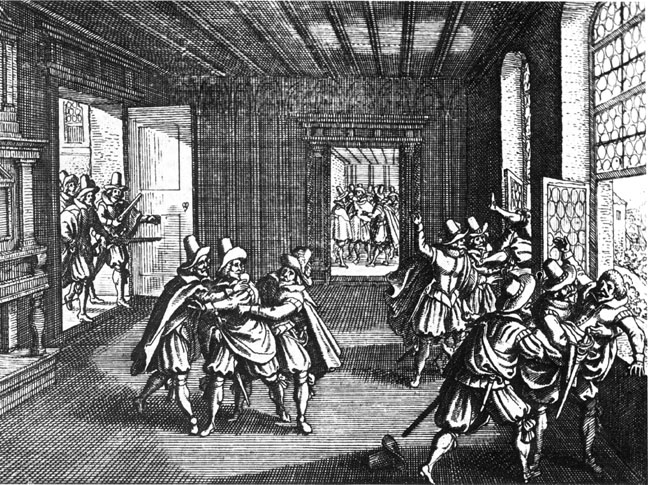

The governors and scribe fell not onto skull-cracking cobblestones, but - some said providentially, others said coincidentally - onto a large pile of manure, and thereby survived the drop unscathed.

Though punished capitally for such high-rise aristicide, Czech Protestants certainly knew how to make an exit.

Comic book fans might remember another notable defenestration, given the recent movie adaptation of the timeless series: Watchmen. While the movie's version isn't quite true to that of the book, it's nonetheless impressive.

Even more impressive: a reverse defenestration, courtesy of Chuck Norris.

So remember, kids, if you ever get kidnapped and held for questioning under pain of death by Czech hypernationalists who despise everything your c0untry stands for, there are worse ways to die. And luckily, it doesn't always work!*****


Information purloined from dictionary.com, New World Encyclopedia, OnlineConversion.com; picture purloined from Wikimedia Commons


* - though arguably if this part of the Old Testament is true, Jezebel might've been the first
** - Unless you count when the Scottish ambassador challenged the king to a cathedral caber-toss
*** - Or petrojected (petro = rock/ject = to throw) at one of the protesters!******
**** - And we're not taking a cue from the Czechs about punishment for First Amendment violators because...?

***** - Defenestration into a railroad spike factory Dumpster greatly diminishes the likelihood of survival
****** - seeing as I only wish this word existed, I do not endorse its use in Scrabble

Friday, July 10, 2009

Puddle, puddle, po-puddle, banana-fana-fo-fuddle, me-my-mo-______

More blog entries forthcoming. Really need to get back on schedule with this thing.

Today's entry is on a versatile word applicable in the realms of the culinary, the artistic and the quotidian, or everyday - which, if improperly used, could do just what this word means: muddle.

The root of muddle is the Middle Dutch verb "moddelen," meaning "to muddy." Soil, besmirch, dirt-encrust - yes, these all are correct - but muddle's commonest meanings are "to mix up or confuse in a bungling manner" and "to mentally confuse."

My first encounter with the word came from playing a video game, Harvest Moon 64. I romanced the rancher girl on the game and, when she fell in love with the hat-clad studmuffin protagonist, the fiery redhead said:

"I like you. Does that muddle things up?"

My character said "no," to which she responded, "Well, then what are you waiting for?"

He went in the for the kiss and she promptly slapped him, saying, "Not that, stupid! The blue feather," the feather being the game's version of a wedding ring. I was left to ponder this exchange, and to discover my newfound word. See, video games aren't useless. They teach you vocabulary!*

Type "muddle" into an ad-sponsored dictionary and you'll get mojito recipes on the side. That's because muddling also refers to crushing or mashing ingredients into one another, a technique used in cooking and bartending. The process makes use of a spoon or, if you have one, a muddler (a rod with a flattened end) to crush the ingredients. The infamous mint julep requires a bartender to muddle mint and sugar inside the serving glass.

Image from Wikipedia

Too many mint juleps might muddle you - muddle also means "to confuse or stupefy with, or as if with, an intoxicating drink."**

If you check American online news with frequency, you might have noticed every politician, journalist and economic analyst using the phrase "muddle through." Though used about subjects ranging from U.S. policy in Afghanistan to the banking crises, the meaning is the same: "to achieve a certain degree of success but without much skill, polish, experience, or direction."

To just plain muddle is "to behave, proceed or think in a confused or aimless fashion, or with an air of improvisation."

Which, if either, is fitting, I'll leave for you to decide.

Psst! Here's a recipe for "The Genuine Cuban Mojito," courtesy of The Bodeguita del Medio in Cuba:

Ingredients

2 tsp sugar
Juice from 1/2 lime
2 mint sprigs
2 parts sparkling water
1 part rum
4 ice cubes

Add the ingredients to a glass, preferably a cylindrical one, in the order above, reserving the rum. Muddle in the glass. Add the rum, followed by the ice cubes. Enjoy!


Information purloined from dictionary.com; image purloined from Wikipedia


* - and that even if you're a self-made man who saves a farm from the brink of extinction and who courts his lady with all the propriety and gentility she is due, you will still be a thoughtless cad
** - in Soviet Russia, drinks muddle YOU!

Reblog this post [with Zemanta]

Wednesday, July 1, 2009

Eye of newt, toe of frog, and a spoonful of sugar to boot

We're a society obsessed with the curative and the instantaneous. Liquid diets promise Gina she'll shed those Thanksgiving 2006 pounds in days. Herb just can't seem to make it with the ladies - if only he had that new Mustang convertible he keeps seeing advertised on the sidebars of his model train webring at 3 a.m. And where would Adrian be without constant, mobile Internet access on her Blackberry to save her the agonizing three minutes of waiting in line at the bank?

In honor of such "contributions" to the commercial market and the illusion they created, today's entry covers the word "nostrum."

Merriam-Webster.com defines nostrum as "a medicine of secret composition recommended by its preparer but usually without scientific proof of its effectiveness," or more generally, "a usually questionable remedy or scheme." The lack of FDA approval for a myriad of untested products makes the nostrum an omnipresent commodity in the good ol' U.S. of A.

Nostrum is also the neuter form of the Latin word "noster," meaning "our" or "our own" - in this case referring to a remedy brewed from a secret recipe all "our own." Its concoctors keep it under wraps for a reason - it often doesn't work, and the desperate will pay for even the hope of a cure. The word entered the English language to refer specifically to quack remedies peddled on the streets of 17th-century London as a plague cure.

America has a history of nostrums stretching back to British imports before the American Revolution and peaking in the 19th century, when charlatans sold such homemade, brand-named cure-alls as Duffy's Elixir,* Dalby's Carminative and Godfrey's Cordial. Most of these were little better than

Clark Stanley's :en:Snake Oil :en:Liniment. Be...Image via Wikipedia

alcohols sweetened with sugar, spices and opiates, and had no real curative effects.

Characteristic of the Manifest Destiny blend of quack remedies
in particular is another American tradition - showmanship. Mark Twain's Huckleberry Finn features a scene of how such scams sometimes ran - a traveling salesman would blow into town, deliver his spiel with volume and verve, and then a shill, or conman masquerading as a customer, would proclaim the medicine's efficacy. Once the swindler sold his inventory, he and the shill would hit the road before the unwitting townsfolk discovered the scam.

Synonyms for nostrum in common usage include "magic bullet,"** "quack remedy," "catholicon" (another word for cure-all***), "patent medicine," "quick fix," and the ever-popular "snake oil" - which, according to an article by Cynthia Graber of Scientific American, might not be so devoid of benefit after all.****

Working mothers at that time did find a use for nostrums such as Godfrey's Cordial, even if they didn't do what they professed to do. Sweet, opiate-based solutions were so palatable to children that those drugged during working hours in their infancy would self-medicate once they had the motor skills to open the bottle. No childproof caps for Reconstruction America, no sirree.

Until next time, this is your language investigator signing off. Have a wonderful evening!

Information purloined from merriam-webster.com, medicinenet.com, historyhouse.com and scientificamerican.com


* - featured in the ancient PC game Oregon Trail 2! Ah, nostalgia.
** - Might need to call Consumer Report about that blender
*** - Subtext: Catholicism will cure your ED
**** - I didn't think there was anyone crazy enough to try to catch a snake, flay it, and press the oil from its skin to test it either

Reblog this post [with Zemanta]

Sunday, June 28, 2009

Fickle heart, fidgeting fingers

I figure that since I've been errant in my usual blogging, I'll compensate by posting a few additional blogs this weekend to act in the missing entries' stead. Today's blog covers the word "dithering." Commonly a British word, I first discovered it in one of my favorite novels, Good Omens by Terry Pratchett and Neil Gaiman:
"Aziraphale was dithering. He'd been dithering for some twelve hours. His nerves, he would have said, were all over the place. He walked around the shop, picking up bits of paper and dropping them again, fiddling with pens. He ought to tell Crowley." (131)
As you might be able to tell, dictionary.reference.com defines dither as "to act irresolutely" or "to vacillate" and, specifically in Northern England, "to tremble with excitement or fear." You are likeliest to dither just before embarking on a daunting but not pressing task, including but not limited to
  • meeting your sweetheart's family
  • chewing through a fallen branch with a chainsaw
  • bungee-jumping from a bridge
Also according to dictionary.reference.com, dither originates from the Middle English word "diddere," meaning "to tremble." Trembling disguised as pseudo-productivity, I might add!* Apparently people have been fidgeting before a fight and slopping their livestock's feeding trough for the third time before their wedding*** since the Middle Ages. Until my next entry today, ladies and germs. Au revoir, and don't fall victim to this aforementioned disease! Information purloined from http://dictionary.reference.com/browse/dithering and http://rosuto.paheal.net/Books/Terry Pratchett & Neil Gaiman - Good Omens.pdf * - Scary Stories audiobook + grueling 9 to 5 job = cushy 9 to 5 job *** - and unlike now, both battle and marriage in the Middle Ages were the linchpins of politics, sometimes even with the former fought over the latter!
Reblog this post [with Zemanta]

Monday, June 22, 2009

The Perfect Solution to the Perfect Storm

Let me start off by saying I apologize for not posting an entry on Friday as I had promised. Someone cut open the plastic window on the back of my girlfriend's Jeep and stole all of her CDs; she and I spent most of the day jury-rigging her window back into place with every mechanic's panacea: duct tape.

At least the thief didn't make off with the car, though he had tried - the wiring beneath the steering wheel was exposed, and the housing around the steering column lay in the footwell on the passenger side.

Yes, I know it was a he.*


Today's entry features one of the words I just used: jury-rig.

To jury-rig something is to construct a quick, temporary solution to a problem out of necessity. It hearkens back - again - to the navy, where "jury" refers to anything used in place of the real thing in an emergency. It specifically refers to a jury-mast, or a temporary mast built to support the sails when the mainmast has collapsed, like the mainmast at the right.

The use of "jury" in this word is debatable, but the leading attribution is a shortening of the word "injury."

For your education: how to tie a jury-mast knot (or mainmast knot, or pitcher knot, depending on what the knot is holding). Here's a video version if you prefer.

:en:Jury mast knot variation :en:ABOK #1167A jury-mast knot.

Sailors tie the jury-mast knot around the jury-mast and use the loops at the side to anchor the mast to stays. Though little evidence exists that such a knot was used in the Age of Exploration, modern sailing texts recommend using this knot for securing the jury-mast.

Also for your education: you cannot jury-rig a courtroom.** You can, however, jurypack a courtroom, which is to stack a jury in such a way as to make a specific outcome likelier.

It is also not "jerry-rig," as some of you might have thought, and as the Brits during the World Wars deliberately used to denigrate the Germans.*** There is a similar-but-not-synonymous word, "jerrybuilt," which refers not to a quick fix but a deliberately shoddy job using slipshod workmanship or second-rate materials to turn a profit. It has its origins in 19th-century England, where it described home builders who followed such a questionable practice.

Curious about synonyms for jury-rig? My favorites include:
  • stopgap, which I would have covered if I could actually find any information about its origin;
  • substitute, though it doesn't mean a jury-rigged teacher;
  • and finally, MacGyver, the original magician of makeshifts in all of his '80s glory.
I use MacGyver as a verb. I encourage you to do the same.


Information purloined from http://www.word-detective.com/back-g2.html

* - well, her tampons and lotion were still there...

** - unless you convert the loo into a hall of justice


*** - The British called their chamberpots "Jerries" after Jericho, the rough area of Oxford, and the German helmets resembled British chamberpots.****

**** - it's also subtler than "$&!@head"


Reblog this post [with Zemanta]

Wednesday, June 10, 2009

Laughing at Unfortunates

Before you say anything, this entry's title is also the title of a Monty Python sketch. I don't condone this act.

Unless you're my brother, who made me choke on bubble tea while laughing, and to whom in retaliation I did the same thing.

Today's entry means exactly the title of this post, or at least it can be one form of it. Schadenfreude (pronounced SHA-den-froid-uh, despite the nasty habit of truncating it in the U.S. to SHA-den-froid) means taking sadistic pleasure at someone else's misfortune.

Parsed into schaden and freude, a literal translation yields "harm-joy" ("harm" for schaden and "joy" for freude - remember, froid-uh).

Don't lie; you've felt it before. If you detested Bush, you relished when Iraqi journalist
Muntadar al-Zaidi hurled his shoes at the former president. When a piggish casanova's date throws champagne in his face, you might want to toss him another glass to wash it down.* What about when an arrogant skateboarder kisses a park bench groin-first? Maybe it would be nobler to check on him, but I have to admit that I might crow a bit first.

Keep in mind that the punishment, though it needn't fit the crime, must be deserved to in turn deserve schadenfreude. Why bad things happen to good people is a question better answered by Murphy's Law.

Schadenfreude is an unseen force patching the holes in law enforcement; the celebration of karmic backlash; a reason for treasuring the virtuous life. Another phrase for schadenfreude in commoner usage is "poetic justice."

Speaking of which, if anyone has a definition of what prosaic justice is, I would value your input. An article from National Review Online's Andrew C. McCarthy defines it as the "the even-handed administration of the law, day in and day out, without fear or favor
."

Seeing as prosaic means "commonplace" and because sometimes justice is anything but, I think that definition hardly...does it justice.

Adieu, adieu - before I make any
more terrible puns.


Information purloined from http://www.word-detective.com/010506.html


* - or an entire bottle**


** - possibly broken over his head

Monday, June 8, 2009

With mirth laughter let old wrinkles come.

Ladies and gents, hello, greetings, salutations and "how's your mom?"

It is a cross-cultural characteristic of humans that we love to laugh. Varying cultures have subtle nuances to forms of humor, however - some prefer sarcasm, others slapstick, still others practical jokes.

My friend in Native American studies at UCF told me European settlers slaughtered a group of Native Americans because, in the latter's culture, one of their most beloved jokes was to steal something from a friend and then wait for him to slink to the thief's house, tail between his legs, and to ask for it back.

The Europeans neither knew nor thought it was a joke, and met the "crime" with force.

Which, despite the subject, is not funny at all.

With different types of humor in mind, today's word refers to a device favored by many (especially British) comedians for how it defies expectations: the paraprosdokian.

Parsed into its Greek roots, it means "before" (para-) "expectation." The sentence's second part causes the listener or reader to reframe the first part of the second in a new, unexpected context.

One of my favorite examples:

"Outside of a dog, a book is a man's best friend.

Inside of a dog, it's too dark to read." - Groucho Marx

If a rhetorician or comedian should choose to be further fancier, the second part of a paraprosdokian can play on the double meaning of a word or phrase in the first part. This specific device is called a syllepsis.

Example here as well, this time from Cecily in Oscar Wilde's The Importance of Being Earnest:

" 'Oh, flowers are as common here, Miss Fairfax, as people are in London.' "

No wonder the lady-folk fawn all over Oscar. His words are honeyed silver.


I am not liable for any horribly botched attempts to impress women through the use of paraprosdokians, but if you should experience such misfortune, I would love to hear about it. I promise not to laugh at you.*


Information purloined from http://www.socyberty.com/Languages/In-Pursuit-of-the-Perfect-Paraprosdokian.177257 and http://literaryzone.com/?p=146

* - to your face

Friday, June 5, 2009

Welcome, ladies and germs, to my shiny, new blog

For all of the logo- and linguaphiles out there, I plan to regularly update with tidbits about language, idioms, wordplay, puns, etymology and hilarious mistranslations. Once my online class, RTV 3280: Interactive Media, ends, I would like to make my blog more variegated, but for now I will stick to a singular topic. I hope you'll come to like the cut of my blog's jib.

"Cut of your blog's jib?" you might ask. "Why, old boy, that's crazy talk!"And while I would in response ask why you insist on speaking like the Great Gatsby, I suppose I will indulge you just this once.*

The cut of one's jib emerged as a nautical phrase most likely in the Age of Exploration. The jib is any one of various triangular sails that adds additional power to the mainsail. It is at the bow of the ship, connected to the topmast, as in the picture at the left.
Every nation's shipbuilding style resulted in a different sail shape, and a ship's nationality could therefore be determined from the jib.

(Photo courtesy of Wikimedia Commons - http://commons.wikimedia.org/wiki/File:Yacht_jib.svg)

In modern parlance, "I don't like the cut of his jib" is "I don't like the look of him." Though more humorous if so, it need not refer to just the subject's nose. Sir Walter Scott (yay Ivanhoe!) used the phrase idiomatically in his 1824 book St. Ronan's Well, a piece set mostly around a mineral spring. Bravo, Scott, for publishing a book in such an utterly boring setting.

Information purloined from http://www.phrases.org.uk/meanings/cut-of-your-jib.html

* - And every time hereafter