Sunday, June 24, 2012

Pulling on heartstrings, loosening the purse strings

Greetings, all -- whether you're a loyal reader or a newcomer, I welcome you to the Language Loft. I hope to be starting this again in earnest with one Sunday post instead of three weekly posts. I feel as if this schedule will be far more manageable.

Today's entry is about the guy who calls elderly folks and promises in honeyed tones that they've won a sweepstakes, if they would only forward him some money to pay the cost of sending them their winnings. It's about the street vendor claiming that his tonic water changes sweat into a perfume irresistible to the opposite sex.*

We're talking mountebanks, racketeers and snake-oil salesmen -- better known as "con artists." But do you know where the "con" part comes from?

If you think it's related to the con part in "ex-con," guess again -- the latter is a shortened form of "ex-convict." (Though if given enough time one might become the other.)

"Con man" is an abbreviation of "confidence man," named for the way such a crook swindles people not only out of their money, but also their trust. The term originated with the serial watch-thief William Thompson who, after chatting with his intended victim, would ask him or her, "Have you confidence in me to trust me with your watch until tomorrow?" The victim, called a "mark," would hand Thompson his or her watch, and the thief whom the New York Herald dubbed the "Confidence Man" walked off with a shiny bit of clockwork to sell. Thompson was arrested in 1849, but his nickname stuck, and soon came to describe all sorts of thieves and the confidence games (American English) or confidence tricks (British English) they plied in 19th-century New York.

Though people have been bilking each other for probably as long as currency has existed, 19th-century America was a particularly fertile seedbed for confidence games and words coined about them:

  • According to dictionary.reference.com, the terms "con man", "confidence game" and the verb "con" all entered American English in the mid-19th century.
  • The Spanish Prisoner game has hornswoggled people since at least the 1860s, according to the New York Times. The swindle originally entailed the con artist claiming to be in contact with a wealthy political prisoner incarcerated in Spain. The con artist offered to let the mark provide some of the funds required to secure the prisoner's release in exchange for a larger reward later from the wealthy prisoner. Of course, the mark never received this reward. This con survives in the modern day as advance-fee fraud.
  • The term "goldbrick," all one word, also emerged from the mid-1800s to describe a bar of heavy, base metal, usually lead, gilded to resemble solid gold and sold as such. The word has since gained new life as a verb, meaning to shirk responsibility, perform something halfheartedly, or to loaf (dictionary.reference.com).
  • The shell game has existed since Ancient Greeks first used it to swipe each other's cold, hard drachma,** but the term first appeared as an Americanism in the 1880s, referring to the nutshells and pea used instead of the typical three cups and ball (pictured in Hieronymus Bosch's "The Conjurer"; note the con artist's accomplice swiping the player's coinpurse on the left-hand side).***

While conning involves a fair bit of prop use and often sleight-of-hand, the crux of a confidence game is always emotional manipulation. That's why stories about cons are as commonplace as a penny on the sidewalk. As much as we'd like to believe ourselves skeptical and perceptive enough to spot a crooked deal, we're only human. We want to believe the armchair we bought at the garage sale is worth the millions the "appraiser" says it is, so we pay her an advance fee to ensure the chair fetches a good price at auction. Never mind that we've never heard of Whitcombe-Whipple's Disease -- we fork over a few bills to the sharp-dressed man collecting money for it because we want to believe we're good people. And why advertise that there's $100 in one of these soap bar packages unless there is one there? Surely not to just sell soap! Why, that would be...a very effective way to sell soap.

Oh.

Therein lies the problem. Con artists, they're a two-cans-of-hair-gel kind of smooth. They trick us into believing that they're just like us by working on what makes us human -- our faith in each other -- and worst of all, they look good doing it.
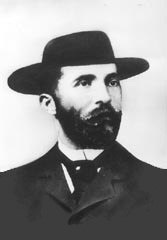
I mean, check out "Soapy" Smith at left, the 19th-century con man who gained national notoriety for selling soap just as I've described above. What a hunk, right? He's probably really clean, too.

...OK, maybe ol' Soap isn't the best example.

Seriously though, just think of the number of movies and books featuring conning as a motif, if not the core, of the work. Neil Gaiman's American Gods; Frank Oz's Dirty Rotten Scoundrels; Spielberg's Catch Me If You Can, based off the real-life cons of Frank Abagnale, Jr.; Eric Garcia's Matchstick Men and Rian Johnson's The Brothers Bloom all spring to mind. Let's not forget the number of movies featuring Paul Newman and Robert Redford as the dashing outlaws or swindlers you can't help but love. Moreover, we're following the story from the con men's perspective more often than not. It's almost as if we're...glorifying them.

Steal our hearts too, whydontcha.

'Til next time, logophiles.


Information purloined from dictionary.reference.com, Britannica Academic Edition, British Bankers' Association, The New York Times and The Lost Museum at CUNY; image purloined from Wikimedia Commons

* : Chanel's new fragrance, Eau du Locker Room -- At Least You Don't Smell Like Feet™
(Also, check out a previous entry I have on quack remedies, called nostrums)
** : Note I am not singling out the Greeks. There are gullible people ripe for swindling in every land and culture. But if I were singling out the Greeks, hey, they don't call him Jason "The Golden Fleece" d'Argos for nothing
*** : "Dude, 50 denarii! We be rollin' in mutton, yo"

Friday, September 4, 2009

Adieu, adieu, until we meet again!

Ladies and germs, I relish to say that I am taking JOU 3101 - Reporting this semester at the University of Florida. I regret to say that this class will suspend my activities on this blog.

Reporting requires the completion of an outside story - that is, a story researched outside of class including the words of real people - every week during the semester. The class, professor Mike Foley concedes gleefully, is the hardest course in the College of Journalism and Communications.

I am also assistant director of UF Shakespeare in the Park (name change pending), which will present "Much Ado About Nothing" in the spring of 2010. I plan to give the show no less attention.

With that in mind, I am devoting the lion's share of my energies to my classes and obligations.

Please don't forget about me in the interim! I will return. Thank you, everyone, for reading.

As always, you may contact me - especially if you have tips for stories involving non-mutual friends! - at edwardmbowen@gmail.com. I also have a Facebook account - search for "Mead Bowen."

Peace and hugs,
Mead
Reblog this post [with Zemanta]

Friday, July 24, 2009

For your viewing pleasure!

The Language Loft's first photo slideshow awaits! Click the play button below and check it out. Thanks again to everyone who made this project possible. If anyone has suggestions for the next slideshow's theme or, as always, for another figure of speech in need of research, leave a comment or send me an e-mail.


And another of my favorite uses of the word "idiom," just for kicks:


Have a pleasant day, all.

- Mead

Tuesday, July 21, 2009

Not AWOL...just working.

Hey loyal readers - just wanted to let you know that I haven't been posting for a very important reason. I'm working on a project for this blog - a slideshow of photographs depicting idioms acted out by real, live people!*

If you'd like to be part of this project and live in the Gainesville, Fla. area, feel free to e-mail me at edwardmbowen@gmail.com and we can set up a time to get you in a photo before Friday.

Thanks folks! I'll have this slideshow up and running on here by Friday at the latest.

- Mead


* - as opposed to fake, dead people**
** - poking fun at my own redundancies

Wednesday, July 15, 2009

When screened-in porches just won't do

For every cricket in existence, technology owns a bug itself. Tech support operators equal, if not exceed, the number of exterminators on the planet (ducks and bats and the like not included). Malfunctioning machines and insects are so numerous, and so akin - they buzz, hum, annoy and require monthly maintenance to prevent - that at times they just beg you to open the window and let them out.

With that in mind, the subject of today's blog proceeds accordingly:

the word "defenestrate."


Hehehehe...had you going there, didn't I?

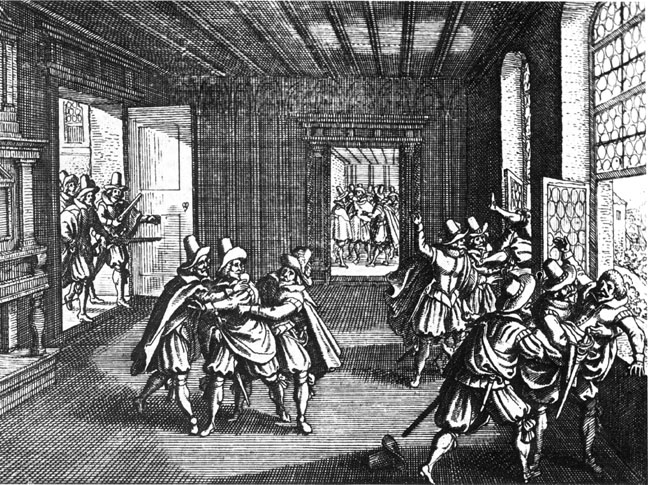
The word "defenestrate" originated in the early 1600s* and comes from the root "fenestra," Latin for window. Parsed up into de/fenestrate, it means in this case out of/window - literally, "the act of throwing something, or especially someone, out of a window."

Probably the most famous defenestrations in history were the First and Second Defenestrations of Prague. Even if you were an attentive scholar, you probably thought there was only one famous Czech window-toss.**

Though it wasn't called a defenestration until its successor made history, the First Defenestration of Prague occurred on July 30, 1419. It began with the march of an armed congregation of Czech Hussites through the streets of Prague, protesting the imprisonment of several of their fellows. They marched to the New Town Hall, where the Catholic councilors refused to even make a prisoner exchange.

That's when an Anti-Hussite had the bright idea of throwing a rock*** at one of the protesters.

What goes up must come down. Several of the crowd stormed the New Town Hall and all seven of the councilors came down, through the window and onto the upright spears of the protesters below.

For the Protestants in 1618 who had heard of this former triumph, the preliminaries to the Second Defenestration must have seemed déjà vu. In 1617, Roman Catholic bigwigs ordered builders to abandon construction of several Protestant churches on allegedly Church-owned land. The Protestants claimed it belonged to the king and was, therefore, theirs upon which to build. They treated this development as the denial of a basic right, and feared the denial of other rights for Protestants was soon to follow.

After a few meetings, the riled non-Catholic nobility barged into the Bohemian Chancellery at Prague Castle. The crowd tried two despised governors, both staunchly Catholic and notorious persecutors of Protestants, for violating the Right of Freedom of Religion.****

Old habits die hard, and amid cheers and shattered glass, the convicted and their scribe plummeted 16 meters (that's 52.5 feet, folks) to the ground.


The governors and scribe fell not onto skull-cracking cobblestones, but - some said providentially, others said coincidentally - onto a large pile of manure, and thereby survived the drop unscathed.

Though punished capitally for such high-rise aristicide, Czech Protestants certainly knew how to make an exit.

Comic book fans might remember another notable defenestration, given the recent movie adaptation of the timeless series: Watchmen. While the movie's version isn't quite true to that of the book, it's nonetheless impressive.

Even more impressive: a reverse defenestration, courtesy of Chuck Norris.

So remember, kids, if you ever get kidnapped and held for questioning under pain of death by Czech hypernationalists who despise everything your c0untry stands for, there are worse ways to die. And luckily, it doesn't always work!*****


Information purloined from dictionary.com, New World Encyclopedia, OnlineConversion.com; picture purloined from Wikimedia Commons


* - though arguably if this part of the Old Testament is true, Jezebel might've been the first
** - Unless you count when the Scottish ambassador challenged the king to a cathedral caber-toss
*** - Or petrojected (petro = rock/ject = to throw) at one of the protesters!******
**** - And we're not taking a cue from the Czechs about punishment for First Amendment violators because...?

***** - Defenestration into a railroad spike factory Dumpster greatly diminishes the likelihood of survival
****** - seeing as I only wish this word existed, I do not endorse its use in Scrabble

Sunday, July 12, 2009

"Give 'im a taste of the boatswain's rope-end, early in the morning!"

One of the prerequisites for sons of veterinarians is an appreciation for animals. I've owned cats all my life, and my parents adopted a rescue dog several years ago, with whom I promptly fell in love. The photo at the left is of me and said dog, Maggie.

Let's make it clear that I'm an equal-opportunity zoophile (ZU-oh-fyle; and not of the sexual kind, smartalecks) before I make an entry for this misunderstood idiom, because
1) I am neither a strict cat person nor a strict dog person
2) I dislike cruelty to animals as much as the next person
3) my father might disown me if he thought otherwise*

With that said, today's entry is a seafaring phrase (notice a pattern?) reviled for its presumed association to animal cruelty: enough room to swing a cat.

The "cat" in this phrase refers to a nasty whip known as a cat o' nine tails, used to punish lawbreaking sailors in the British Royal Navy until the 1800s. This flogging occurred on deck in full view, because below deck the ceilings were too low for the boatswain's (pronounced BO-sun's) mate to swing the whip.

Though other variations existed, the naval cat was made out of rope. Colonial-era rope was made of three thin ropes, each composed of three strands of cotton yarn - when unraveled at the end, nine separate strings would result, giving the whip its nine tails.**

The jury is out on whether they were usually knotted, but most accounts maintain they were. Each would cause intense pain when striping an insubordinate's back. If the crime was theft, the mate would employ the thieves' cat, each of its thongs knotted three times for additional pain (see right). Theft was an especially serious crime aboard a naval vessel.***

Several regulations about usage of the whip existed, but as we innovative humans often do, captains found ways to circumvent them. Though floggings exceeding 12 lashes were subject to court martial, captains often got away with as many as 72 without being caught. The mate put all of his strength into each blow, and if the captain decreed more lashes, another man would deliver the next set of 12 to ensure the punishment's severity.

The song "What Shall We Do with a Drunken Sailor" features a pseudonym for the cat, "the captain's daughter," seeing as in theory the cat was used only with his permission. Whether your version of the song says "give him a taste of the captain's daughter" or "put him in the bed with the captain's daughter," the singers are asking for a flogging.****

That the song requests this punishment doesn't surprise me. Punishment in British, colonial and piratical societies alike was public spectacle. People treated hangings and clapping a criminal in stocks as we might a free benefit concert or a fistfight in the schoolyard.

Nowadays, the use of the cat tends to be a private matter, as any BDSM devotee will discreetly***** tell you. Funny how what was once punishment, some of us today do voluntarily. Maybe some royal sailors deliberately violated the law? Who knows. What I do know is that where our contemporaries want to swing the cat, there's always [a] room [in which] to do it.


Information purloined from Captain Blood's Cove, Broadside, pride-unlimited.com, Pirates of the Caribbean: A Pyrate's Life, dictionary.reference.com; images purloined from Wikimedia Commons and my personal album


* - I may or may not have once fed Maggie a Jujube to point and laugh at her (and I'm kidding about that disownment part)
** - Any thoughts on why people have said cats have nine lives, besides surviving falls from great heights?
*** - one flaskful of liquor smuggled aboard could buy a lot of hardtack - we're talking, like, a 1:5 ratio here******
**** - if you were lucky, maybe even from the captain's daughter*******
***** - or vocally and in graphic detail
****** - What? It works as a deadly projectile if you don't have a rock...
******* - Before anybody gets excited about the further possibility for pirate pornography - yes, there is already a multimillion-dollar two-part series - bringing a woman or young boy aboard was punishable by death
.
Reblog this post [with Zemanta]

Saturday, July 11, 2009

Mead's Online Guide to Using Insults and Escaping While Your Victim Consults a Dictionary

Certain words emerge to represent personalities that serve as fixtures in the community. Scapegoats and sin-eaters bear the guilt for everyone else's trangressions; the gossipmonger collects the tawdry activities of the neighborhood and serializes them; the voyeur enjoys the thrill of watching private moments through a windowpane.

Come to think of it, none of these are positive, are they?

Today's entry is no exception, I'm afraid: it covers one of my favorite words, "curmudgeon." A curmudgeon is defined by dictionary.com as "a bad-tempered, difficult, cantankerous person."

Though the origin is unknown, I'm casting my vote with Walter William Skeat (1835 - 1912), author of several tracts on the English language. He maintained that curmudgeon is a combination of the English word "cur" (a mongrel dog, especially a worthless or unfriendly one) and one of two Lowland Scottish words: "mudgeon" (grimace) or "murgeon" (to mock; to grumble).

Strangely, in modern English dictionaries "murgeon" instead refers to grimace, whereas "mudgeon" isn't listed. "Ker" is also used in a variety of words as a prefix for greater emphasis in onomateopoeic words liked "kerplunk."* I do hope Sherlock Holmes can shed some light on this mystery.

Either way, the word literally translates to "an unfriendly, grimacing/grumbling mongrel dog." Better use this one sparingly, folks.**

Literary curmudgeons include A Christmas Carol's Ebenezer Scrooge, the Harry Potter series's Severus Snape, and To Kill a Mockingbird's morphine-addicted Mrs. Dubose.
Dr. Gregory House of the namesake show has also been labeled as such.

The curmudgeon who comes to my mind is the movie Steel Magnolias's Ousier Boudreaux (as if that it's pronounced "wheezer" isn't clue enough), the laughingstock of her friends with a kinder heart than she tends to show (farthest left in picture).

As literature and movies demonstrate, people are rarely curmudgeons for the sake of being curmudgeonly. Regret, pain or disillusionment gnaws at their roots, souring their moods. But Scrooge's heart thaws when faced with his own mortality, Mrs. Dubose sends a single white camelia to the Finch children as thanks for reading to her, and Ouiser's love for children shows in the smile she gives her friend's son.***

I don't know about House, because I don't watch "House," and if you need a reason why I don't watch "House," you're staring at it.

I suppose that makes me a curmudgeon, too?

I prefer to use the term "selectively cranky."


Information purloined from dictionary.com, the Oxford University Press Blog, and The Mavens' Word of the Day; image purloined from The International Movie Database


* - such as our word's comic-book cousin, KERBLUDGEON!
** - limit usage to your ancient in-laws who never really liked you, and who run about as fast as you can walk
*** - before he bursts into tears